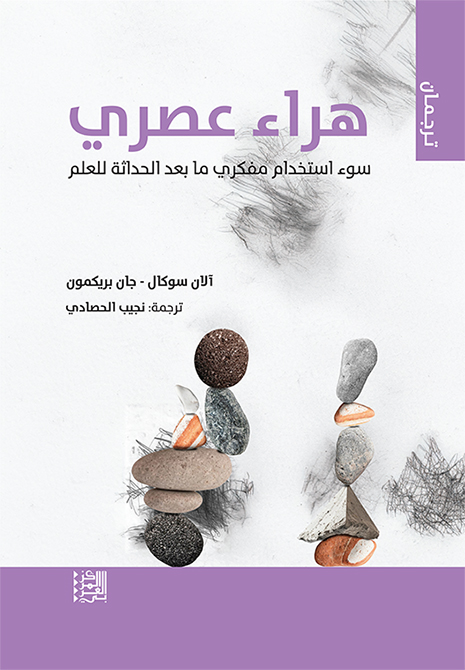
The Arab Center for Research and Policy Studies published the book Fashionable Nonsense: Postmodern Intellectuals' Abuse of Science_, as part of the Tarjaman series. It is written by Alan Sokal and Jean Bricmon and translated by Najib Al-Hasadi. It is 385 pages long, including an introduction that the authors wrote specifically for the Arabic translation, and an introduction to the Arabic translation by a professor and head of the Arabic Philosophy Program at the Doha Institute for Graduate Studies and the head of the Arabic Philosophy Program at the Doha Institute for Graduate Studies. Editing of the periodical Tabyyan by Raja Bahloul, preface to the English edition, and a conclusion, in addition to appendices, a glossary of terms, references, and a general index. ## The foundations of the Western modernity project The Western modernity project was based on a system of philosophical and methodological principles that made rationality, empiricism, objectivity, and progress central values. The modern scientific mind sought to formulate a methodology that would guarantee objectivity and certainty to its observations, experiments, and theories. This mind relied on the integration of two basic pillars: mathematics, with its inferential accuracy and logical rigor, and the experimental method based on careful observation and testing. The fundamental goal of modern science was to control nature and explain its phenomena, in a way that served the economic and industrial development of the West, and established (Western) man’s dominance over the natural world. ## Shifting away from the traditional concept of scientific rationality. On the other hand, postmodern thinkers tried to shift away from the traditional concept of scientific rationality, so they put forward critical visions that targeted the methodological constants of modernity and modern science. These visions were embodied in the slogan “Everything is Permissible,” which in its philosophical context represents a call for methodological pluralism and a rejection of any closed system in the practice of science. They emphasized the concept of cognitive relativism, which shows that the cognitive break with prevailing approaches led to revolutionary discoveries. However, postmodern thought was not spared from deconstruction and criticism. Criticisms were directed at him, accusing him of undermining the rational foundations of science. This criticism was embodied most prominently in Alan Sokal and Jean Bricmont's book Modern Nonsense: The Misuse of Science by Postmodern Thinkers**, which sought to expose contradictions and fallacies in the use of some texts Postmodern thinkers reject scientific concepts, considering them to be empty metaphors lacking precision and rigor. The book focuses on criticizing the epistemological practices of French postmodern thinkers, which the authors describe as intellectual fraud or nonsense. This nonsense lies in the unjustified misuse of precise scientific terms (such as physics and mathematics) out of context by postmodern thinkers in order to give an aura of depth and rigor to their discourse. The main goal of this criticism is to refute the claims of epistemological relativism that reduces science to a social “narrative” (p. 54), while emphasizing that the rejection of rationality by some peoples of the world, especially in the southern part of it, is not a rejection of knowledge itself, but rather a reaction to the use of false scientific slogans by the colonial West - especially the United States of America and Israel.
Fashionable Nonsense Postmodern Intellectuals' Abuse of Science
هراء عصري: سوء استخدام مفكري ما بعد الحداثة للعلم
Translated
Listen to book
Bibliographic Data
| Author | |
|---|---|
| Publisher | Arab Center for Research and Policy Studies |
| Publisher Address | office@dohainstitute.edu.qa |
| Country | Qatar |
| Primary Category | Technologies and Sciences |
| Also In | |
| Published | 2025 |
| Language | Arabic (AR) |
| Pages | 385 pages |
| Edition | First edition |
| Dimensions | 17×24 |
| ISBN | 9786144456781 |
| Translation | Translated |