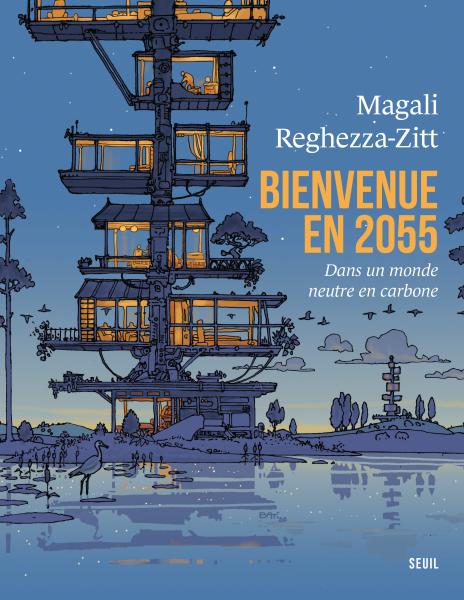
The book “Welcome to 2055: To a Carbon Neutral World” by French author Magali Reghezza\-Zitt is a forward-looking work that combines literary narrative and scientific analysis, in an attempt to reimagine the future of humanity in light of Worsening climate challenges. The book was published by “Sui Publications” in May 2026, and falls within what the author describes as “science-based science fiction”, which is a type of writing that is not separated from realistic data, but rather relies on it to build a possible vision of the future. The work begins from an imagined moment in time, the year 2055, where the writer takes on the voice of a seventy-seven-year-old narrator, looking at the past - that is, our present - with a kind of contemplation mixed with relief and regret at the same time. On the one hand, it expresses its pride in what humanity has been able to achieve in the path of environmental transformation, and on the other hand, it regrets that many did not realize in a timely manner the seriousness of the climate crisis, or preferred to ignore it in order to preserve short-term interests. This tension between delayed awareness and achieved achievement forms the backbone of the text. The book does not present the world of 2055 as an ideal utopia, but rather as a complex reality that has succeeded in achieving a very important goal, which is reaching carbon neutrality, without this meaning the disappearance of environmental problems completely. Temperatures are still high, and may reach harsh levels, but human societies have developed adaptation mechanisms and reorganized patterns of living and production in a way that allows for reducing risks and minimizing losses. In this sense, the book focuses on the idea of “transformation” and not “salvation,” that is, moving from a destructive development model to a more balanced and sustainable model. The importance of this work lies in the fact that it does not limit itself to describing the future, but rather seeks to influence the present. The author, by virtue of her scientific background in geography and environmental risks, implicitly presents the thesis that reaching this future is not inevitable, but rather conditional on a set of political decisions and societal choices. It confirms that the climate issue is no longer just a technical or environmental issue, but has become a democratic issue par excellence, related to how to distribute resources, determine priorities, and involve citizens in shaping the features of the future. The book also highlights a clear criticism of the discourses that sought to reduce the seriousness of climate change or postpone confronting it, as the narrator shows how these positions would have almost cost humanity dearly, had it not been for the transformations that occurred later. On the other hand, the text gives space for appreciation of the environmental and social struggles that contributed to changing public policies and pushing them towards adopting a more sustainable path. In conclusion, “Welcome to 2055” presents a model of writing that combines warning and hope, as it places the reader before an achievable future scenario, not as a comfortable promise, but as a possibility that requires collective awareness and a firm political will. Through this balance between realism and ambition, the book succeeds in transforming the environmental question from a mere scientific concern into an existential issue that affects the shape of human life in the coming decades.
Welcome to 2055: a carbon neutral world
مرحبًا بكم في 2055: في عالمٍ محايد كربونيًا
Translated
Listen to book
Bibliographic Data
| Author | |
|---|---|
| Publisher | Éditions du SeuilWebsite |
| Publisher Address | contact@seuil.com |
| Country | France |
| Primary Category | Technologies and Sciences |
| Published | 2026 |
| Language | Arabic (AR) |
| Pages | 256 pages |
| Edition | First edition |
| Dimensions | 20×15 |
| ISBN | 9782021603521 |
| Translation | Translated |