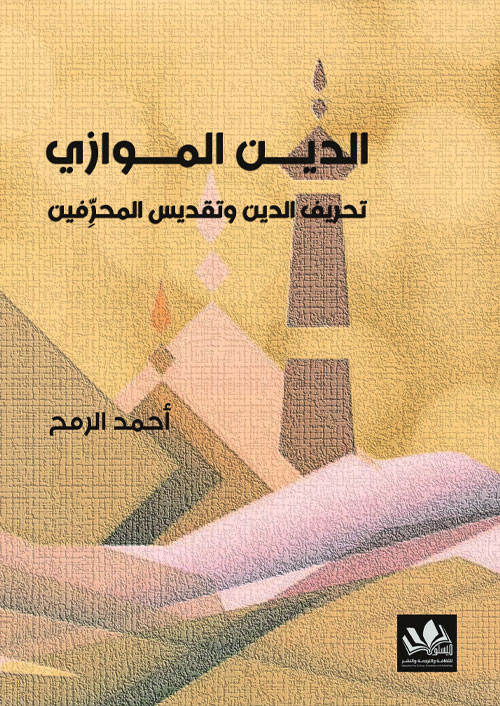
At a time when Arab societies are experiencing a difficult intellectual struggle between the hammer of extremism and the anvil of Westernization, the “**Maysaloun Foundation for Culture and Translation” issued And publishing **” A new book by the Syrian researcher Ahmed Al-Ramh under the title: "Parallel religion: distorting religion and sanctifying the distorters". The 232-page book does not limit itself to refuting contemporary religious discourse, but also delves into the anatomy of the psychological and social structure that allowed the emergence of an “alternative religion” that competes with the original and replaces it. The Making of “Contemporary Idols” In his book, Al-Rahm starts from a shocking premise: We are not only living in the domestication of religion, but we are also living under a “parallel religion” that was created according to political and social interests. The first chapter focuses on the issue of "sanctification of distorters", where the author points out that the danger lies not only in distorting the text, but in transforming the "interpreter" or "preacher" into a human idol to whom falsehood does not come from before it or from behind it. This sanctification - according to the book - is what protects distortion and prevents reason from exercising its critical role. Mechanisms of falsifying consciousness Throughout the book’s chapters, Al-Ramh explains how the higher goals of Sharia law (freedom, justice, dignity) were replaced by formal rituals and marginal conflicts. The researcher believes that “parallel religion” relies on three basic pillars: 1. Cognitive flatness: Providing easy and canned answers to major issues. 2. Emotional incitement: Using the language of intimidation and enticement to disrupt logic. 3. Learning power or money: to ensure the spread of this model across broad media platforms. From preaching to social anatomy What distinguishes this edition is its departure from the guise of traditional preaching books. Spear, known for his background in the study of civil society, offers a "sociological anatomy" of the religious phenomenon. He believes that "rebuilding man" is the only way out of the tunnel of backwardness, considering that renaissance begins when the individual regains his ability to distinguish between "divine religion" and "human ideology" that is cloaked in the cloak of religion. Intellectual echoes The book comes at a sensitive time, as the need for enlightening readings that confront the trends of political Islam and religious populism increases. Critics have considered that “Parallel Religion” represents a qualitative addition to the Arab library, as it puts the finger directly on the wound: The problem of religiosity is not in the “texts” as much as it is in the “guardians” of them. The book is currently available through the platforms of the Maysalon Foundation in Paris and Istanbul, in addition to electronic copies that have begun to find widespread popularity among readers interested in critical thought.
Parallel debt; Distortion of religion and sanctification of distorters
الدين الموازي؛ تحريف الدين وتقديس المحرِّفين
Translated
Listen to book
Bibliographic Data
| Author | |
|---|---|
| Publisher | Maysaloun for Culture, Translation and Publishing |
| Publisher Address | Info@maysaloon.fr |
| Country | Turkey |
| Primary Category | Religions and Beliefs |
| Also In | |
| Published | 2026 |
| Language | Arabic (AR) |
| Pages | 232 pages |
| Edition | First edition |
| Dimensions | 17×24 |
| ISBN | 978-625-5873-24-8 |
| Translation | Translated |