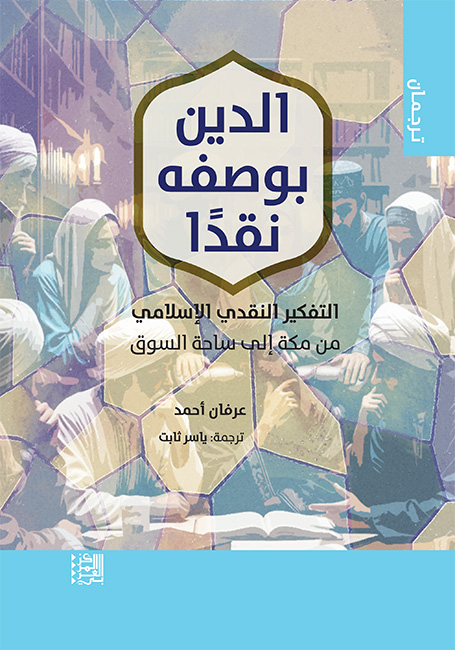
The Arab Center for Research and Policy Studies published the book Religion as Critique: Islamic Critical Thinking from Mecca to the Marketplace as part of the Tarjuman series, written by Irfan Ahmed and translated by Yasser Thabet. It is 408 pages long, including an introduction, a preface, and seven chapters divided into two parts, a conclusion, references, and a general index, in addition to tables and pictures. Religion as a Critical Actor: Towards Moving Beyond Western Centralism The book seeks to reformulate the relationship between religion, reason, and criticism, proposing a different reading of the idea that has long dominated modern Western thought, which is that criticism is an exclusive phenomenon of Western modernity and secular rationalism. Instead of considering religion a subject of criticism, Ahmed believes that it, especially Islam, can be a critical actor in its own right, possessing its own tools and logic for questioning reality and power. This thesis represents a bold attempt to destabilize prevailing intellectual assumptions, dismantle the West's centrality in defining critical thought, and expand the concept of criticism to include other cognitive and religious traditions. In addition, the importance of the book lies in its ability to restore religion as a critical, creative force capable of questioning reality and inspiring change. Criticism in the Islamic Context: Concepts and Everyday Practices The book is based on a careful historical and philosophical analysis of the concept of “criticism” as it was formed in the West since the Enlightenment, when it was linked to freedom from religion and empirical rationalism, to become a standard for modernity and progress. However, Ahmed shows that this model has a Western, self-centered character. It implicitly assumes that every intellectual or spiritual practice outside the Western framework lacks a critical tendency. In this context, he makes his major contribution by demonstrating that the Islamic heritage has deep roots for critical thinking, and that Islamic concepts, such as piety, diligence, enjoining good, forbidding evil, and advice, all constitute patterns of criticism, because they call for holding oneself, authority, and society accountable according to moral and spiritual standards that transcend individual or political interest. Ahmed presents a thriving critical tradition in Islamic culture, especially in South Asia, drawing on references from multiple languages. The book shows that criticism in the Islamic context is not just an intellectual or philosophical activity, but rather a life practice that permeates the details of daily life. Markets, mosques, and public councils are all spaces in which forms of practical and social criticism are practiced, which is based on dialogue, accountability, and the search for justice. Accordingly, the importance of the book’s subtitle: Islamic Critical Thinking from Mecca to the Market. Deconstructing Orientalism and Redefining Modernity On the other hand, Ahmed criticizes the idea that Islam is merely a “subject” of Western analysis, pointing out that this Orientalist perspective overlooks the fact that Islamic thought has produced, throughout its long history, rich critical traditions, whether in jurisprudence, philosophy, Sufism, or politics. In this context, he reviews examples of reformist thinkers (Abu al-Ala al-Mawdudi, for example), who practiced a double criticism. A critique of Western hegemony, and a critique of the deviations within Islamic societies themselves. By analyzing the discourses of these thinkers on issues of the Islamic State, the role of women, and social justice, Ahmed shows that Islam is not content with conforming to reality, but rather always seeks to reform and correct it according to its moral principles. Ahmed emphasizes that restoring consideration to the critical dimension in religion does not mean justifying religious ideologies or intellectual closure, but rather aims to liberate the concept of criticism itself from its Western monopoly, and recognize that each culture has its own ways of thinking, questioning, and evaluating. Hence, he believes that the strict separation between rationality and spirituality that prevailed in modern thought is only a limited cultural construct that does not reflect the diversity of human experiences. The book concludes with the necessity of redefining modernity itself, as a multifaceted project, whose standards and meanings are not monopolized by Western thought. Islamic modernity, as he understands it, is not the opposite of Western modernity, but rather another reading of modernity from within a different historical and religious experience. Through this proposal, the way is opened for a new global dialogue on religion, criticism, and reason, based on mutual recognition and cognitive parity between cultures.
Religion as Critique Islamic Critical Thinking from Mecca to the Market Square
الدين بوصفه نقدًا التفكير النقدي الإسلامي من مكة إلى ساحة السوق
Translated
Listen to book
Bibliographic Data
| Publisher | Arab Center for Research and Policy Studies |
|---|---|
| Publisher Address | office@dohainstitute.edu.qa |
| Country | Qatar |
| Primary Category | Religions and Beliefs |
| Also In | |
| Published | 2025 |
| Language | Arabic (AR) |
| Pages | 408 pages |
| Edition | First edition |
| Dimensions | 17×24 |
| ISBN | 9786144456996 |
| Translation | Translated |