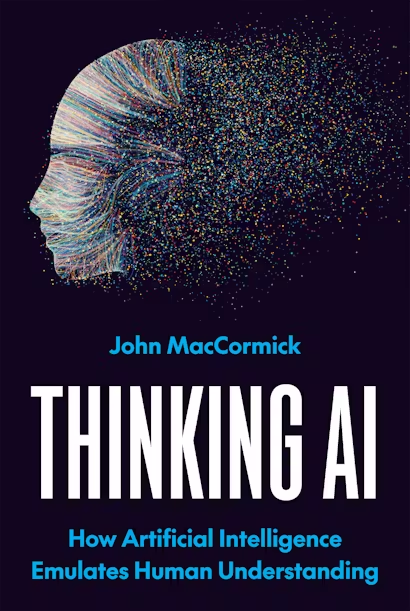
Can machines think? Since Alan Turing posed this question in an influential paper in 1950, it has become a central focus of artificial intelligence research. More than seventy-five years after Turing's paper, we still face this question whenever we wonder whether Watson is actually smarter than the heroes of Jepardi!, or whether ChatGPT really understands what it is saying. In his book "**Thinking AI**", computer scientist John McCormick explores the Turing question from a perspective informed by a nuanced understanding of how modern artificial intelligence systems work. McCormick explains, in simple terms, the ideas behind the two cornerstones of the 21st century AI revolution: deep neural networks and reinforcement learning. McCormick provides a tour of the most famous AI systems, including AlexNet and VGG16, two Nobel Prize-winning deep neural networks for object recognition; And DeepMind's AlphaGo program, which astonished AI researchers with its extraordinary performance in the game of Go. And OpenAI's ChatGPT, which has amazed the world with its natural language processing capabilities. McCormick describes how each system works, and points out similarities to the processes of the human brain. He explains that both human minds and computer programs are capable of generating intelligence through emergence_: that is, the ability of new phenomena to emerge from the interactions of many small, simple components. Does this mean that a computer program is capable of thinking like a human? In many ways, McCormick says, the answer is yes. In his book Intelligent Thinking, he reveals new horizons for emerging intelligence, a world in which computer programs can emulate many or all aspects of human thinking, with humanity retaining its meaning and purpose.
Thinking AI: How AI mimics human understanding
الذكاء الاصطناعي المفكر: كيف يحاكي الذكاء الاصطناعي الفهم البشري
Translated
Listen to book
Bibliographic Data
| Publisher | Princeton University PressWebsite |
|---|---|
| Publisher Address | info@press.princeton.edu |
| Country | USA |
| Primary Category | Technologies and Sciences |
| Published | 2026 |
| Language | Arabic (AR) |
| Pages | 296 pages |
| Edition | First edition |
| Dimensions | 16×23 |
| ISBN | 978-0691290836 |
| Translation | Translated |