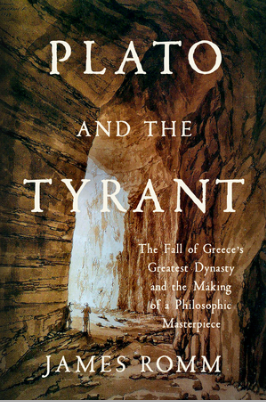
Plato and the tyrant | The fall of Greece's greatest dynasty and the making of a philosophical masterpiece
أفلاطون والطاغية | سقوط أعظم سلالة في اليونان وصناعة تحفة فلسفية
One of the best books of the year according to Foreign Affairs magazine: “\[Excellent\]... a brilliant and engaging work of history, philosophy and biography... a kind of intellectual thriller.” \- Becca Rothfield, The Washington Post. From a prominent historian and classical scholar, an insightful portrait of the philosopher Plato, showing how the ideas contained in his masterpiece, The Republic, were tested by violent events in the most powerful Greek city of the era. Plato is considered one of the most influential thinkers in history, a "Semitic philosopher" whose writings still form the foundation of Western culture. He is best known for his eloquent dialogues in which he depicts his teacher Socrates discussing moral truths with prominent figures in Athens. However, the image we have of Plato – an ideal figure removed from society and politics, conjuring up abstract thoughts in quiet woods – is a fantasy, woven by his admirers and accumulated over the centuries. In fact, Plato was a man immersed in life. In his book Plato and the Tyrant, renowned historian and classical scholar James Rome draws on Plato's personal letters—documents long forgotten—to show how one philosopher helped bring down the dominant Greek power of the era: the wealthy city of Syracuse. There, Plato met two autocrats, a father and son, both named Dionysius, and tried to direct them toward philosophy. At the same time, he was working on his masterpiece, The Republic, in which he envisioned a ruler who combined perfect wisdom with absolute power. This dream has resonated through the ages and led to the emergence of a famous term, which Plato himself did not use: “the philosopher king.” As Röhm reveals, Plato's stay in Syracuse contributed to the formation of the Republic, but also produced disastrous results for Plato himself and for the entire Greek island of Sicily. Dionysius the Younger, emotionally unstable but intellectually curious, welcomed Plato warmly, but the relationship quickly turned sour. Plato's close friendship with Dionysius' uncle, Dion - which may have been a romantic love bond - led to a rift in the ruling family, leading to a chaotic civil war. Combining suspenseful political drama with an exploration of Plato's most important ideas, Rom takes us into the heart of Late Classical Greece, an era in which many believed democracy had failed. Plato's search for solutions prompted him to write his impassioned plea for a new political order, and also led him to a place where he believed his theories were applicable. But Plato and the Tyrant shows how Plato's experiment with enlightened absolutism turned into a disaster, and at the same time offers us a new account of the origins of Western political thought.
Bibliographic Data
| Publisher | to downloadWebsite |
|---|---|
| Publisher Address | info@wwnorton.com |
| Country | USA |
| Primary Category | Philosophies and Cultures |
| Published | 2025 |
| Language | Arabic (AR) |
| Pages | 368 pages |
| Edition | First edition |
| Dimensions | 6×9 |
| ISBN | 978-1324093183 |
| Translation | Translated |