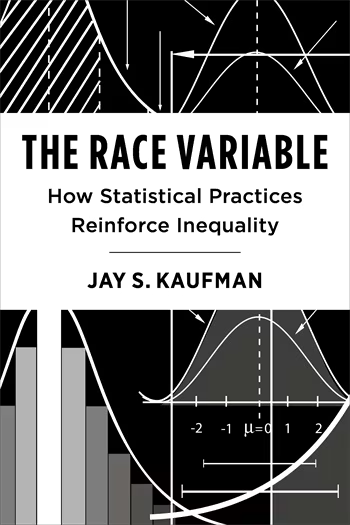
متغير العرق .. كيف تعزز الممارسات الإحصائية عدم المساواة
متغير العرق .. كيف تعزز الممارسات الإحصائية عدم المساواة
From social science and biomedical research to government and media reports, statistics on racial and ethnic disparities are everywhere. However, the numbers we usually encounter do not provide direct comparisons. Researchers analyze data using adjustments, such as regression models, to address bias and confounding factors. However, many common statistical practices produce misleading results, some of which are based on faulty assumptions that inadvertently distort inequalities between groups. Presented by Jay S. Kaufman provides a clear, easy-to-understand guide to understanding the use and misuse of statistics on racial and ethnic disparities. By examining dozens of real-world examples spanning medicine, economics, education, and criminal justice, he shows how conventional statistical practices—no matter how well-intentioned—have obscured the realities of injustice, with disastrous consequences for public policy. Kaufman addresses how to select and apply statistical adjustments responsibly and systematically, and suggests ways to better explain and analyze racial and ethnic inequalities. Aimed at readers who are not specialists in statistics, this book provides a basic introduction to quantitative thinking in the context of social justice. The Race Variable is suitable for undergraduate and graduate students in various branches of the medical and social sciences—including sociology, demographics, public health, epidemiology, medicine, and public policy—who focus on racial and ethnic disparities, and for all readers interested in the statistical underpinnings of our understanding of inequality.
Bibliographic Data
| Publisher | Columbia University Press |
|---|---|
| Publisher Address | ips@ingramcontent.com |
| Country | USA |
| Primary Category | Social Studies |
| Also In | |
| Language | Arabic (AR) |
| Translation | Translated |
| Keywords | جاي إس. كوفمان |