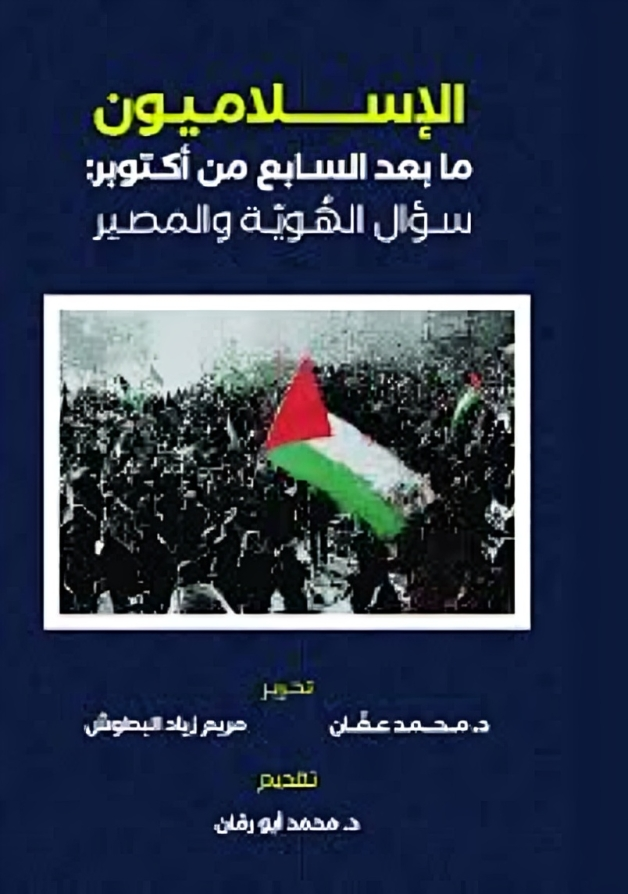
The Institute of Politics and Society, in partnership with the Middle East Council for International Affairs and the Orient Forum, issued the book “[Islamists after October 7th: The Question of Identity] And fate](https://politicsociety.org/2026/03/25/%D8%A7%D9%84%D8%A5%D8%B3%D9%84%D8%A7%D9%85%D9%8A%D9%88%D9%86-%D9%85% » In the context of my research, it monitors the structural transformations that occurred in the Islamic movements after “Seventh of October,” and anticipates their possible paths in the next stage. The book presented to him by Dr. Muhammad Abu Rumman, academic advisor to the Institute of Politics and Society and professor of political theory at the University of Jordan, edited by Dr. Muhammad Affan, an expert in political Islam movements, in addition to the assistant researcher at the institute, Maryam Al-Batoush, discussed the repercussions of “Seventh of October” on various Islamic actors, their transformations between the Arab Spring and the Al-Aqsa flood, and its expected effects on the strategies and choices of these movements in an attempt to anticipate their future and outcomes. In the context of my research, it seeks to dismantle questions of identity and destiny in light of accelerating regional transformations. ## Political Islam: From the Arab Spring to October 7 The first chapter was devoted to discussing the two events that the book considers to have the most impact on the current state of political Islam: The Al-Aqsa Flood and the rise of Hay’at Tahrir al-Sham to power in Syria. Muhammad Abu Rumman’s paper focused on the impact of the Syrian transformation on political Islamic movements, considering that the experience is still in its infancy and that it is still early to judge its outcomes and impact. The paper concluded with two possible and conflicting effects: the possibility of deepening the radical tendency within some of the bases of political Islam, versus the possibility of pushing other movements towards more pragmatism and seeking regional and international recognition through “calculated concessions.” With regard to Salafist jihadism, the paper discussed the impact of the transformations on the rise of “local jihadism” on the one hand, and the opportunities it may provide for the Islamic State (ISIS) to renew the narrative of “global jihadism” on the other hand. Muhammad Affan’s paper also addressed the impact of the Al-Aqsa Flood on the political Islamic movements, especially in the countries of the Encirclement (Egypt, Jordan, and Lebanon), and started from the hypothesis that the event was expected to constitute a “kiss of life” for these movements, before concluding that what happened - so far - has deepened their crisis, whether at the level of their relationship with their bases, or at the level of the official Arab regimes’ use of the event to expand the circles of repression and political exclusion under the headings of combating terrorism. ## Hamas and Islamic Jihad: The Dilemma of Options in an Uncertain Future The second chapter of the book discusses the transformations of the Hamas and Islamic Jihad movements in Palestine in the post-war period. In his paper «Hamas...the dilemma of options after the cessation of war, Dr. Tariq Hammoud, a researcher in Palestinian studies, reviewed the most prominent challenges facing the movement as a resistance movement and a ruling authority at the same time: the challenge of internal restoration, restructuring, and filling leadership vacuums; The challenge of renewing popular legitimacy in Gaza by transforming war sacrifices into livelihood and service gains; The challenge of establishing regional accreditation within an acceptable political cost for partners. In the context of transitional governance arrangements, the chapter discussed how the movement seeks to keep its influence “non-zero” despite its exclusion from direct administration. For his part, the paper by researcher in political sociology, Khaled Zawawi, addressed the complex crisis that the Islamic Jihad movement is going through after the war stopped: the decline in military capacity, the difficulty of transforming into a political organization in light of the complexities of political practice under occupation, in addition to the challenges of the relationship with the Palestinian Authority, which links political participation to the terms of reference of the settlement agreements. ## Lebanese Hezbollah: The Question of Political and Military Destiny In the third chapter of the book, the conversation turned to Hezbollah, and how the Battle of the Flood radically changed the party’s local and regional equation, after the heavy losses that the party suffered by targeting its Secretary-General, its military leaders, its fighting forces, and its weapons stores, and after the fall of the Syrian regime, and the twelve-day war that targeted Iranian military leadership, its weapons, and its nuclear facilities. The specialist in geopolitical transformations and Islamic groups, Muhannad Al-Haj Ali, focused in his paper on the local political dimensions of the transformations that the party is going through, as he showed that the political alliance of the party called “March 8” has receded so that the party is positioned in its Shiite environment, within a bilateral equation with the Amal Movement. Then Al-Haj Ali returned to clarify that even the inter-relations within this “duo” are marred by differences in political positions, which, although they remain hidden, are likely to escalate in the future, to summarize. In the end, there was a shift in the party’s positioning, saying that the party “moved from a position of formulating regional and local policy, to a defensive position to preserve the remnants of its weapons and political role.”
Islamists after October 7: The question of identity and destiny
الإسلاميون ما بعد السابع من أكتوبر: سؤال الهوية والمصير
Translated
Listen to book
Bibliographic Data
| Author | |
|---|---|
| Publisher | Institute of Politics and Society |
| Publisher Address | info@politicsociety.org |
| Country | Jordan |
| Primary Category | Ideas and Policies |
| Published | 2026 |
| Language | Arabic (AR) |
| Pages | 116 pages |
| Edition | First edition |
| ISBN | 978-9923-0-2275-7 |
| Translation | Translated |