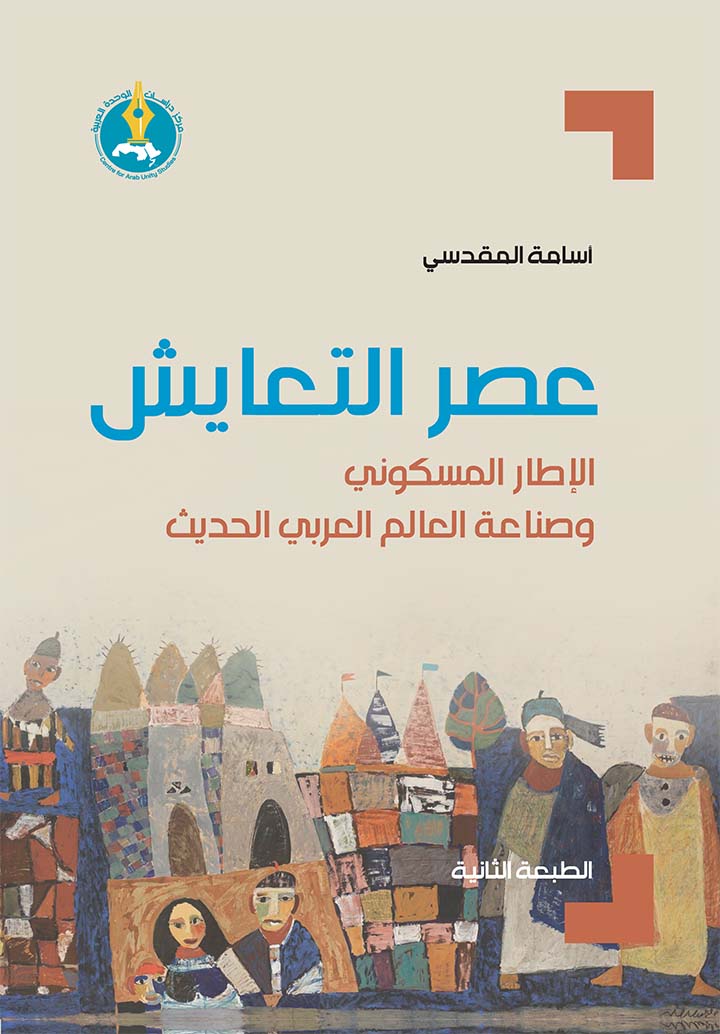
The Center for Arab Unity Studies issued the second edition of the book The Age of Coexistence: The Ecumenical Framework and the Making of the Arab World Hadith By Dr. Osama Al-Maqdisi. This book explains how the modern culture of coexistence appeared in the Arab Levant under the Ottoman Empire in the nineteenth century, and continued until after the fall of the Ottoman Empire, when European colonial powers repeatedly sought to exploit the rich, diverse, and ecumenical religious and ethnic diversity of the Middle East to weaken and disintegrate the region and thus control its fate and future. These colonial powers worked to divide the region and encouraged local tyranny formed according to their whims. It also encouraged the big lie that claims that our region is haunted by the chronic problem of sectarianism, ignoring the geographical, cultural, epistemological and political distortions that the region has actually been exposed to, in which European and American imperialism played a fundamental role. But in order to tell this history of coexistence as a history – not a fantasy, a wish, an ideology, a problematic, or a self-loathing – we must be able to accept contradiction and imperfection. We must honestly confront the Islamic, Ottoman and Arab past as it was, not as we want it to be. We also have to understand why in the modern era we resort to romantic narratives about the bygone golden ages. But in order to accomplish this serious historical work, and to make it meaningful to any liberation project, we must first shed inherited colonial notions of our inferiority vis-à-vis a West that has completely transformed itself into a myth. The book includes six chapters divided into two parts, as well as an introduction and conclusion.
The Age of Coexistence: The Ecumenical Framework and the Making of the Modern Arab World
عصر التعايش: الإطار المسكوني وصناعة العالم العربي الحديث
Translated
Listen to book
Bibliographic Data
| Author | |
|---|---|
| Publisher | Center for Arab Unity Studies |
| Publisher Address | مركز دراسات الوحدة العربية |
| Country | Lebanon |
| Primary Category | Social Studies |
| Also In | |
| Published | 2026 |
| Language | Arabic (AR) |
| Pages | 304 pages |
| Edition | First edition |
| Dimensions | 17×24 |
| ISBN | 978-614-498-463-5 |
| Translation | Translated |