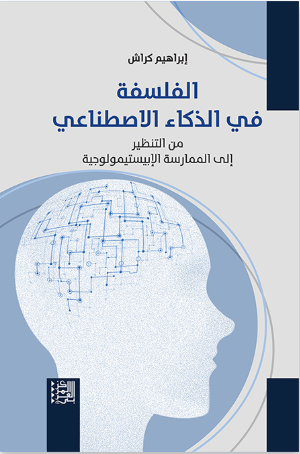
الفلسفة في الذكاء الاصطناعي
الفلسفة في الذكاء الاصطناعي
Published by the Arab Center for Research and Policy Studies, the book [Philosophy in Artificial Intelligence](https://www.dohainstitute.org/ar/BooksAndJournals/Pages/philosophy-and-artificial-intelligence-from-theory-to-epistemological-practice.aspx): From Theory to Epistemological Practice, written by Ibrahim Karash, is 257 pages, including a summary. Executive summary, an introduction, and four chapters, in addition to a conclusion, references, and a general index. The book aims to explore the deep relationship between artificial intelligence and philosophy by analyzing the epistemological and intellectual foundations of artificial intelligence, and highlighting how it has become, as a scientific and technical field, a topic of extremely important philosophical reflection. The book indicates that artificial intelligence grows within a complex cognitive and technical system that can be summarized with the word “logos.” It seeks to dismantle the philosophical backgrounds of this project, through a critical presentation of the intellectual positions presented by John Searle and Hubert Dreyfus, and to shed light on two basic philosophical references: They are: the representational tradition (rational and experimental) and functionalism. From the mechanization of thought to the philosophy of machines The book Philosophy in Artificial Intelligence deals with the development of the idea of artificial intelligence from its philosophical roots to its contemporary scientific formation, stressing its close connection to epistemological thought. Since the Middle Ages, philosophers have expressed their desire to mechanize thought, including: Raymond Lull, who designed a symbolic machine, and Blaise Pascal, who created a mechanical machine for calculation. As for René Descartes, he rejected the idea of machines being able to think, arguing that consciousness and language go beyond the limits of mechanics. In contrast, Gottfried Leibniz saw thought as capable of symbolic representation. With the development of symbolic logic and the invention of the Turing machine, the science of computing was established and artificial intelligence began to present a field that aims to simulate human abilities such as vision, language, and reasoning, but we are still far from achieving intelligence similar to humans. The problem of defining intelligence - whether human or artificial - is still unresolved. Intelligence is viewed as a human characteristic associated with perception, learning, and problem solving, while artificial intelligence seeks to model these processes, despite our limited understanding of thought and the brain. Diversity of concepts and philosophical criticism Definitions of artificial intelligence vary depending on cognitive backgrounds: there are researchers who focus on representing knowledge, and others who focus on biological simulation, or on processing symbols, or even performing human-like tasks. However, this field is not considered a unified science, but rather a multidisciplinary field that combines informatics, philosophy, linguistics, psychology, and neuroscience. Researchers such as Daniel Andler believe that artificial intelligence is still an incompletely developed scientific field. This cognitive overlap opens new doors for thought for philosophy, and pushes it to reconsider its traditional concepts such as understanding, free will, and intentionality. Artificial intelligence has contributed to reformulating classic philosophical questions, such as the limits of the mind, the nature of perception, and what it means to think. However, there are philosophers who have criticized this field, pointing out its inability to represent true understanding, and the separation of the machine from the body and the world, which weakens its ability to simulate intelligent behavior.
Bibliographic Data
| Author | |
|---|---|
| Publisher | Arab Center for Research and Policy Studies |
| Publisher Address | office@dohainstitute.edu.qa |
| Country | Qatar |
| Primary Category | Technologies and Sciences |
| Also In | |
| Language | Arabic (AR) |
| Pages | 257 pages |
| Edition | الأولى |
| Dimensions | 24*17 |
| ISBN | 9786144456705 |
| Translation | Not Translated |
| Keywords | الذكاء الاصطناعيالفلسفة |