السعي نحو الصفر: إزالة الكربون من البيئة العمرانية على طريق مستقبلنا الحضري
السعي نحو الصفر: إزالة الكربون من البيئة العمرانية على طريق مستقبلنا الحضري
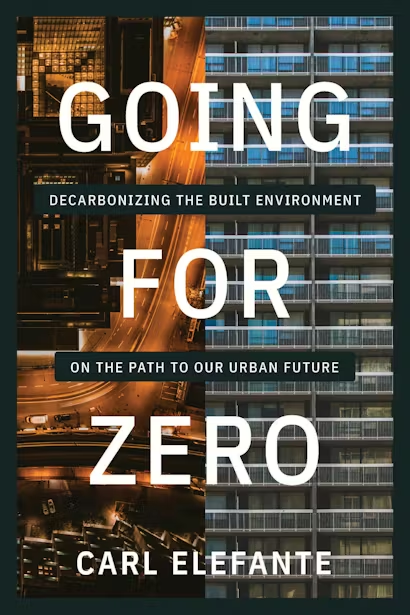
Climate change is no longer a theoretical threat. Day after day, an already disruptive climate impacts the lives of millions, and the time available to curb climate change is alarmingly limited. Achieving zero greenhouse gas emissions requires a comprehensive restructuring of every aspect of industry, agriculture, transportation, and every city and town people inhabit. The work of architects, civil engineers, landscape engineers, city designers and others who shape the built environment has never been more important. Reducing carbon emissions in the design, construction and operation of buildings is a radical shift that is already changing professional principles and practices. In Going for Zero (https://press.princeton.edu/books/paperback/9781642833553/going-for-zero) Decarbonizing the Built Environment on the Path to Our Urban Future, veteran architect and former president of the American Institute of Architects Carl Elefanti examines how buildings and cities can and should contribute to solving the impending climate crisis. Elefante offers a completely alternative point of view, drawn from his career in architecture, where he saved buildings from unwarranted demolition, and drew on practices and wisdom rooted in architectural heritage. For architects and others working together to design human habitations, the demands of the 21st century require a radical shift in thinking, from a mindset of expansion to a mindset of reintegration and recovery. Elefante asserts that reducing the climate crisis, addressing intractable social and economic injustice, and launching the urban era on a truly beneficial and adequate path are all challenges that must be addressed through urban architecture. The book addresses the challenges of our built environment and possible solutions in four sections: The Climate Imperative, The Justice Imperative, The Urban Development Imperative, and Postmodernism. Elefante explains that revitalizing communities through optimal use of available resources makes social, economic and environmental sense, directing resources to where they are needed most.
Bibliographic Data
| Publisher | Island PressWebsite |
|---|---|
| Publisher Address | info@press.princeton.edu |
| Country | USA |
| Primary Category | Technologies and Sciences |
| Language | Arabic (AR) |
| Translation | Translated |