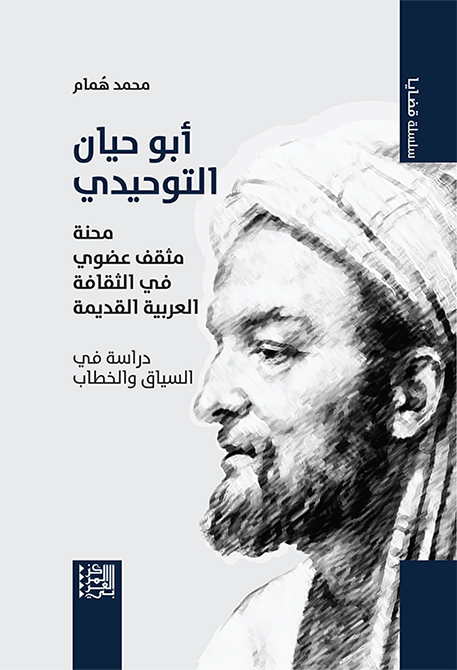
The Arab Center for Research and Policy Studies published the book Abu Hayyan al-Tawhidi: The Plight of an Organic Intellectual in Ancient Arab Culture, a Study in Context and Discourse, by the author Muhammad Hammam, which is 336 pages long, including an executive summary, an introduction, two chapters, a conclusion, references, and a general index. The book seeks to build an in-depth interpretive reading of the biography of the ancient Arab intellectual through the model of Abu Hayyan al-Tawhidi, reviewing his interaction with his social environment, his cognitive formation, and his cultural production. It is not limited to recounting his biography, but goes beyond that to raise fundamental questions about the position of the intellectual and his function in the structure of ancient Arab society compared to the intellectual of the modern era. It discusses Al-Tawhidi’s relationship with authority and the scientific elite, and the limits of his interaction with the prevailing culture, in addition to his approach to the incoming culture, especially Greek. Through this complex interaction, the image of the intellectual is presented as a social and political actor, not an isolated being. ## Al-Tawhidi between the writer and the critic The book deconstructs the image of Abu Hayyan, asking: Is he just an interesting writer or an insightful critic? Was he a transmitter or maker of the cultural scene? Was he the owner of an intellectual and critical project and a bold stance towards his society? These questions make his biography a mirror of the life of the organic intellectual in classical Arab culture, and place him at the center of the question of cultural identity and position on authority and society. He is an intellectual of the fourth century AH. He is not a writer who secludes himself in his tower. Rather, he is an actor in the daily fabric. He carries his eloquence as a weapon, and his voice is a source of concern for the authorities. ## The Voice of Rejection and the Authority of the Word Al-Tawhidi’s book stands out as a free, organic intellectual who resisted authoritarian temptations and refused to be a decorative tool for rule or a rhetorical façade for the clergy. His project was a critical act that exposed falsehood and spoke on behalf of the marginalized, and thus he experienced the bitterness of hostility and denial. In this, he preceded many others in assuming the role of an intellectual involved in public affairs, in a way that later resembled Emile Zola in his famous article “I Accuse,” and concepts such as the “organic intellectual” and the “committed intellectual” according to Michel Foucault and Edward Said...etc. Al-Tawhidi was ahead of his time, did not separate knowledge from conscience, and did not compromise on the word.
Abu Hayyan Al-Tawhidi: The plight of an organic intellectual in ancient Arab culture
أبو حيان التوحيدي: محنة مثقف عضوي في الثقافة العربية القديمة
Translated
Listen to book
Bibliographic Data
| Author | |
|---|---|
| Publisher | Arab Center for Research and Policy Studies |
| Publisher Address | office@dohainstitute.edu.qa |
| Country | Qatar |
| Primary Category | Philosophies and Cultures |
| Published | 2025 |
| Language | Arabic (AR) |
| Pages | 336 pages |
| Edition | First edition |
| Dimensions | 22.5*15.5 |
| ISBN | 9786144456798 |
| Translation | Translated |
| Keywords | التوحيدي |