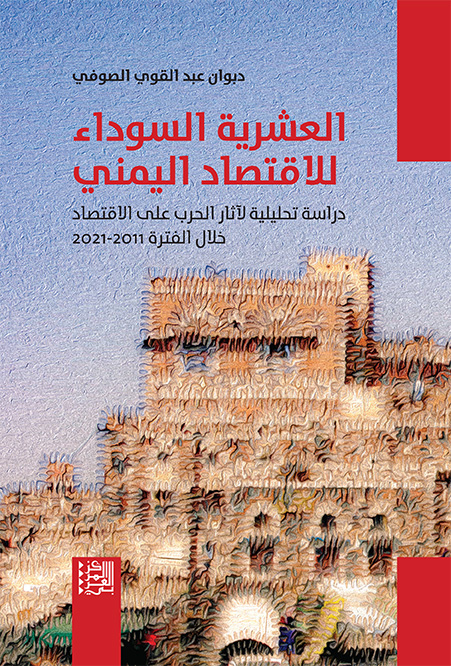
The Arab Center for Research and Policy Studies published the book The Black Decade of the Yemeni Economy: An analytical study of the effects of the war on the economy during the period 2011-2021, written by Dabwan Abdul Qawi Al-Sufi, as part of a series of publications, and is 212 pages long. The book includes an introduction, four chapters, and a conclusion, in addition to tables, figures, appendices, references, and a general index. It is highlighted that the civil war that broke out in 2015 led Yemen to lose what remained of the components of the state, as institutions collapsed and the social fabric disintegrated. Economically, all sectors were paralyzed, unemployment, poverty, and inflation rates rose to unprecedented levels, and human development indicators declined significantly. The war resulted in a humanitarian crisis that has been described as the largest crisis in the modern era, and has plunged Yemenis into a state of indifference towards their affairs, with a continuous depletion of national resources. However, hope remains possible thanks to the Yemeni economy’s potential for recovery, provided that there is a national will and joint efforts to emerge from the cycle of war. ## The roots of the crisis and its paths This book shows that in 2011, Yemen entered a new phase of instability due to the Arab Spring protests, affected by accumulated political and economic crises and deep-rooted corruption. Historically, Yemen has suffered divisions and wars, and unity between north and south was achieved in 1990, but it was hasty, and produced a state burdened with problems, which led to civil war in 1994. After a short period of relative stability and limited economic reforms, the crises worsened in the first decade of the twenty-first century, coinciding with the growth of political differences and the outbreak of confrontations with the Houthis. During the 2011 protests, the country entered a more complex path that ended in civil war in 2014 and foreign intervention in 2015. The results were economically disastrous; The domestic product collapsed, poverty and unemployment rates rose, and the value of the national currency deteriorated, causing the war to cause profound changes in the economic and social structures. This book seeks to analyze the effects of the crisis between 2011 and 2021 through two approaches: One is descriptive, the other is analytical, comparing the situation to what it was before the crisis (2001–2010). It focuses on several indicators, such as domestic product, unemployment, inflation, and productive sectors, aiming to provide a comprehensive view of the damage caused and suggest paths for treatment. It is divided into four chapters: the political situation and structure of the Yemeni state before the war, the economy between 2001 and 2010, the economy between 2011 and 2021 and the effects of the war on its sectors, and an approach to possible solutions after assessing the damages. The book monitors the features of the political and economic environments after unification until the outbreak of war, highlighting the path of democratic transformation that included party pluralism, elections, and a growth in the role of the media and civil society, before the civil war undermined that by destroying institutions and the decline of political life in favor of weapons.
The black decimal of the Yemeni economy
العشرية السوداء لـ الاقتصاد اليمني
Translated
Listen to book
Bibliographic Data
| Author | |
|---|---|
| Publisher | Arab Center for Research and Policy Studies |
| Publisher Address | office@dohainstitute.edu.qa |
| Country | Qatar |
| Primary Category | Philosophies and Cultures |
| Also In | |
| Published | 2025 |
| Language | Arabic (AR) |
| Pages | 212 pages |
| Edition | First edition |
| ISBN | 9786144456835 |
| Translation | Translated |
| Keywords | الاقتصاد اليمنيالحرب الأهليةاليمن |