مساحة للتنفس: هندسة الكائنات الهوائية
مساحة للتنفس: هندسة الكائنات الهوائية
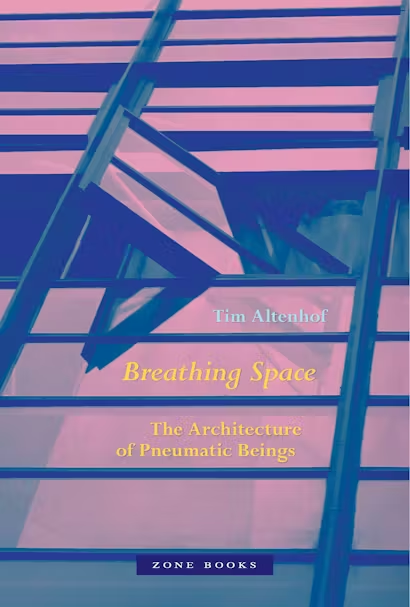
“Space to Breathe” offers a compelling and comprehensive analysis of pneumatic phenomena in contemporary culture. Architect and historian Tim Altenhoff brilliantly explores the physiology of breathing and its interrelation with objects and buildings, all of which share a common environment. Because breathing is controlled by the autonomic nervous system and cannot be controlled voluntarily, it occurs subconsciously and involuntarily most of the time. However, starting in the mid-nineteenth century, the outlook on breathing changed significantly. Breathing has become a widely studied cultural and physiological phenomenon, and has formed the basis of techniques and physical practices that promote pulmonary awareness. New understanding of air pollution and disease has stimulated widespread interest in ventilation, influencing architecture in countless ways. Altenhof's in-depth readings of built structures show how pneumatology has been integrated into architecture, whether in the design of factories, housing, or medical facilities. The lungs form a major part of the respiratory system and, unlike any other organ, directly connect the living body to its surroundings. However, the role of the lungs also poses a topological problem: by participating in transporting air through the atmosphere, the lungs dissolve the separation between inside and outside, and despite being an internal organ, they maintain a constant and vital connection with the outside world. This ambiguity and permeability constitute the spatial dimension of breathing.
Bibliographic Data
| Publisher | Island PressWebsite |
|---|---|
| Publisher Address | info@press.princeton.edu |
| Country | USA |
| Primary Category | Technologies and Sciences |
| Language | Arabic (AR) |
| Translation | Translated |