سيرة فكرة خطيرة: تاريخ جديد لمفهوم العِرق من لويس الرابع عشر إلى توماس جيفرسون
سيرة فكرة خطيرة: تاريخ جديد لمفهوم العِرق من لويس الرابع عشر إلى توماس جيفرسون
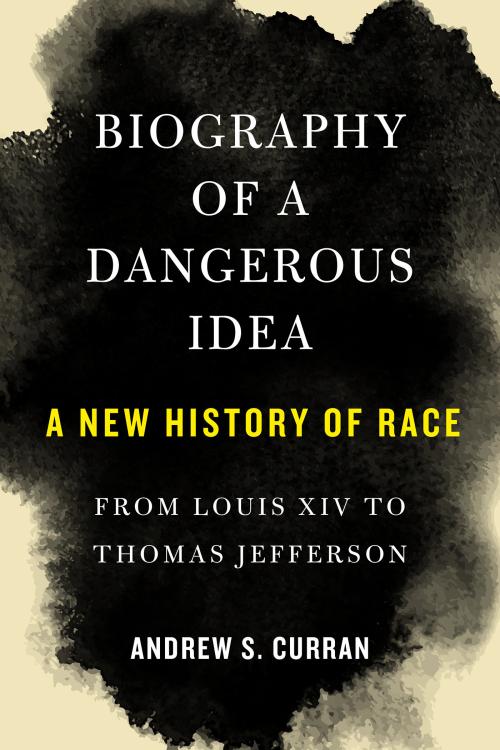
American historian and writer Andrew S. Curran, in his book The Biography of a Dangerous Idea: A New History of the Concept of Race from Louis The book starts from the basic premise that the idea of race, as we know it today, was not a fixed or ancient concept, but rather a historical product shaped by a complex interaction between the then emerging science, European imperial projects, and networks of slavery and colonialism. By 1800, many Enlightenment thinkers had contributed to redefining the human being within categorical “natural” and “biological” categories, which later paved the way for the justification of broad forms of domination and exclusion. In his narrative, Kurian focuses on a group of influential figures who contributed, directly or indirectly, to building this perception, such as Louis XIV, Voltaire, David Hume, Immanuel Kant, all the way to Thomas Jefferson. He presents them not only as thinkers or rulers, but as part of an intellectual and political network that reshaped Europe's understanding of the world and of humanity itself. The book moves between wide geographical spaces that reflect the extension of this idea across empires, from the luxurious palaces of Versailles in France, to the slave plantations in the Caribbean, through the Mughal court in India, all the way to the house of Monticello in the United States. This spatial movement reflects, according to the author, the deep connection between the production of scientific knowledge and the colonial reality that nourished and directed this knowledge. One of the book's most important theses emerges in its revelation of the intersection between the European Enlightenment project and systems of colonial oppression and slavery. While the Enlightenment is usually viewed as an era of reason, freedom, and progress, Kurian shows that this era itself was implicated in producing human categories that entrenched inequality on allegedly “scientific” grounds. The book also re-evaluates a number of intellectual “flags” at that stage, without falling into simplistic condemnation or glorification, but rather by deconstructing the contexts within which they worked, and the intellectual and political restrictions that shaped their vision of the world. In this sense, the work does not aim to judge history as much as it seeks to understand how ideas that continue to influence the present were formed. The writer points out that the danger of the idea of “race” does not lie only in its subsequent political use, but rather in the moment of its first formation, when human difference was transformed into fixed categories that were assumed to be natural and unchangeable. This transformation, according to the book, was a pivotal moment in the history of Western thought, because it established a model of thinking that continues to produce its effects today. In conclusion, Biography of a Dangerous Idea** offers a critical historical reading that reopens the file of the Age of Enlightenment from a different angle, revealing the tension between the discourse of rationality on the one hand, and the practices of domination and colonialism on the other. In doing so, it not only retells the history of the idea of “race,” but rather raises a broader question about how major ideas are formed in turbulent historical moments, and how these ideas can be transformed into tools of influence whose effects extend across the centuries.
Bibliographic Data
| Publisher | Other PressWebsite |
|---|---|
| Publisher Address | editor@otherpress.com |
| Country | USA |
| Primary Category | Philosophies and Cultures |
| Also In | |
| Language | Arabic (AR) |
| Translation | Translated |