التظاهر بالموت: كيف تفهم الحيوانات الموت
التظاهر بالموت: كيف تفهم الحيوانات الموت
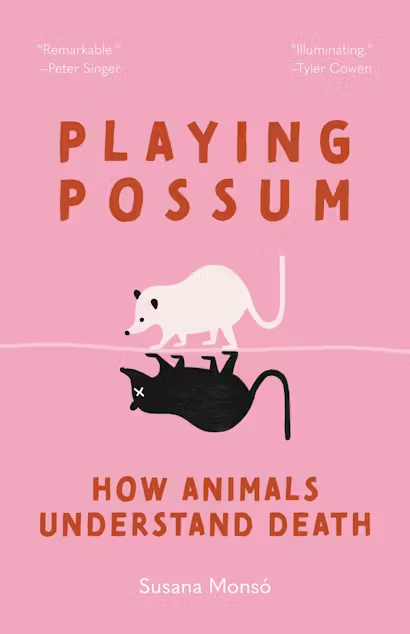
In his book, "Feigning Death," the author examines whether animals are capable of perceiving death - from dogs mourning their owners to killer whales mourning their young. This book may seem strange, as it belongs to a relatively new field of research known as “comparative death science” and “focuses on animals’ reactions to death or dying, and the psychological mechanisms behind these reactions.” In a blog that defines itself as concerned with the intersections of philosophy, psychology, and mental health, Suzana Monceau recently wrote about a recent book she published in English. The author is an associate professor of philosophy in the Department of Philosophy, Logic, History, and Philosophy of Science at the National University of Distance Education in Madrid, and specializes in the philosophy of animal minds, ethics, and the philosophy of comparative psychology. Her book, recently published by Princeton University Press, is entitled “Playing the Role of a Corpse: How Do Animals Understand Death?”. Susanna Monceau wrote, “Humans have become accustomed to thinking of themselves as ‘animals with a concept of death,’ but recent years have witnessed a surge of recent studies indicating that we may not be alone in paying attention to this phenomenon. A chimpanzee was seen cleaning the teeth of the corpse of a teenager from her group with whom she had a strong relationship, crows gathered around the bodies of her dead to determine the circumstances of death, small elephants were also discovered, apparently buried by large elephants, and bereaved whales were seen carrying the body of their son.” "The little one over a period of 17 days over a distance of more than a thousand miles." Monceaux adds, “In my book ‘Playing Corpse: How Animals Understand Death’ I argue that a proper study of the relationship between animals and death requires us to overcome two biases that plague our contemporary discussions of this topic. The first of these biases is what I call ‘intellectual anthropocentrism,’ meaning that the only way to understand death is through the human way. This intellectual anthropocentrism has led us to overthink the concept of death, which has been linked to very difficult abilities such as theory of mind or reasoning.” abstraction, the concept of absence, or standard thinking.”
Bibliographic Data
| Publisher | Princeton University PressWebsite |
|---|---|
| Publisher Address | info@press.princeton.edu |
| Country | USA |
| Primary Category | Technologies and Sciences |
| Also In | |
| Language | Arabic (AR) |
| Translation | Translated |