
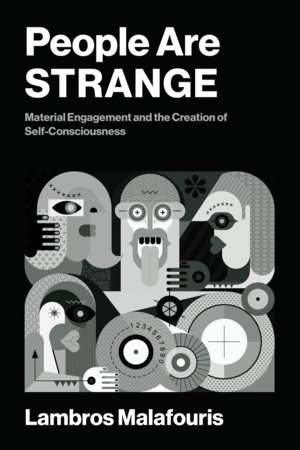
People Are STRANGE: Material Engagement and the Creation of Self-Consciousness is a recent work by Professor Lambros Malafouris, Professor of Cognitive and Anthropological Archeology at the University of Oxford, published by MIT Press in February 2026. The book offers a revolutionary vision of how human consciousness is formed, not as a purely internal process in the brain, but as a result of constant interaction with the physical world around us. ## The basic concept of the book - the meaning of the abbreviation (STRANGE): The subtitle STRANGE refers to the phrase “Situated TRANsactional GEnesis”. The author argues that self-awareness is a “strange state” that characterizes human beings and arises at the intersection of mind and matter. - Material Engagement Theory (MET): Malafouris applies this theory to prove that the boundaries of the self do not stop at the skin or the skull, but rather extend to the tools and physical environments that we participate in making or dealing with. - Going beyond the separation between subject and object: The book criticizes the traditional Cartesian principles that separate the mind from the physical world, suggesting that “self-bounding” is a dynamic process that changes as our physical environments change. ## The most prominent themes of the book - Consciousness as Becoming: The book believes that human becoming is a continuous evolutionary process (Human Becoming), where manual activities such as making pottery or playing musical instruments play a role in formulating our concept of the “ego.” - Metaphysics and Culture: Explores how human consciousness transcends the traditional dichotomy between what is natural and what is cultural. - Digital selves: In its final chapters, the book addresses how consciousness and the self extend in the modern digital age. - Tools and the pre-history of the “ego”: It examines the historical origins of the use of tools and how “liberation of the hand” contributed to the emergence of self-awareness. ## The importance of the book The book is considered an important reference in the fields of cognitive effects, philosophy, and anthropology, as it presents an alternative to the models of classical cognitive psychology, stressing that we do not only use things, but that things are what shape our minds and our identities. Would you like to delve deeper into a specific chapter of the book or learn more about the physical engagement theory established by the author?
Eccentric People: Physical Engagement and the Creation of Self-Awareness
الناس غريبو الأطوار: الاشتباك المادي وخلق الوعي الذاتي
Translated
Listen to book
Bibliographic Data
| Publisher | Mitpress Publishing House |
|---|---|
| Publisher Address | mitpbooks-rights@mit.edu |
| Country | USA |
| Primary Category | Philosophies and Cultures |
| Also In | |
| Published | 2026 |
| Language | Arabic (AR) |
| Pages | 352 pages |
| Edition | First edition |
| Dimensions | 15×22 |
| ISBN | 9780262385640 |
| Translation | Translated |