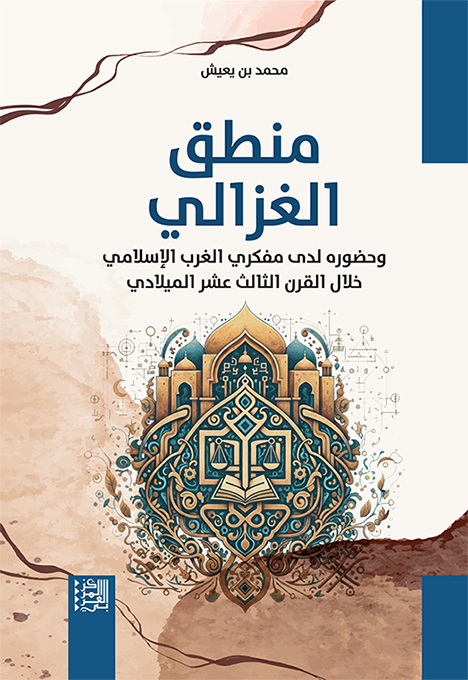
The Arab Center for Research and Policy Studies published the book Al-Ghazali’s Logic and His Presence among Thinkers of the Islamic West during the Thirteenth Century, by the author Muhammad ibn Ya’ish. It is a new approach to studying the mixture that occurred between Aristotelian logic as formulated by Al-Ghazali and the sciences of the principles of jurisprudence in Arab-Islamic culture, especially in the Islamic West. The book aims to highlight Al-Ghazali’s contribution to establishing a new understanding of the relationship between logic, jurisprudence, and theology, and to explain the role of Western Islamic thinkers in developing this legacy within their own philosophical and fundamentalist contexts. It focuses on the nature of Al-Ghazali's intellectual presence and the influence he had on the writings of the regions, philosophers, and theologians of the Islamic West. His position here is measured by the extent of the space he occupied in the logical/fundamentalist discourse of these people, and by the extent of their interaction with his project that aimed to adapt logic within Islamic culture, and to establish a balanced link between wisdom and Sharia, and between rational proof and the principles of jurisprudence. The book examines the quality and limits of this influence, and how Western Islamic thinkers became involved in developing the major milestones established by Al-Ghazali in linking Aristotelian logic with jurisprudence. He proposes an approach based on a new reading of the problem of integrating logic into principles, by following two parallel paths in the Islamic West: the first rejects this integration, and the second supports it. The rejectionist position is represented by Ibn Rushd, who considered logic to be a science different in its starting points from the principles of jurisprudence, and believed that combining the two would lead to methodological confusion. He clearly expressed this position in his summaries, stressing the necessity of keeping logic in its purely evidential field. On the other hand, a broad trend of Ibn Rushd’s contemporaries and students emerged, such as Ibn Maimon, Al-Mukalati, and Ibn Tamlus, who defended Al-Ghazali’s project and saw logic as an essential tool for defending the faith and preserving fundamentalist thinking. They adopted a vision that acknowledges that Aristotle’s logic, in its form by Al-Ghazali, is capable of serving jurisprudential and theological research, and that its integration into the principles of jurisprudence strengthens the structure of religious discourse. This contrast between the two schools is the focus of the book’s problem. The author highlights how the team supporting Al-Ghazali contributed to the expansion of the presence of Aristotelian logic in its “religious/fundamentalist” form in the Islamic West, in contrast to Ibn Rushd’s almost complete disregard for this logic. Through this, the book redraws the map of intellectual interaction between the East in the person of Al-Ghazali and the Islamic West in the person of its regions and philosophers, within a complex relationship in which the logical intertwines with the fundamentalist, and the philosophical with the verbal. Thus, Al-Ghazali’s book Logic becomes an attempt to re-read one of the aspects of the deep connection between the Islamic East and West, by understanding how Al-Ghazali’s project circulated and its influence in building a distinctive logical/fundamentalist discourse among an elite group of Islamic Western thinkers, in opposition to a strict critical position represented by Ibn Rushd. He concludes that studying this interaction reveals an intellectual dynamic of great importance. Al-Ghazali’s presence was not merely a transfer of his views from the East to the West, but rather it was a matter of controversy and reconstruction within different cognitive environments. By analyzing the conflicting positions, the author shows that the project of integrating logic into the principles constituted a real moment in Islamic intellectual history, which resulted in a complex discourse that preserved the essence of Aristotelian logic, but redirected it to serve religious purposes. This made the Islamic West a fertile arena for this interaction to mature and transform it into an influential scientific tradition, according to a clear methodological vision.
Al-Ghazali’s logic and his presence among Western Islamic thinkers during the thirteenth century
منطق الغزالي وحضوره لدى مفكري الغرب الإسلامي خلال القرن الثالث عشر
Translated
Listen to book
Bibliographic Data
| Publisher | Arab Center for Research and Policy Studies |
|---|---|
| Publisher Address | office@dohainstitute.edu.qa |
| Country | Qatar |
| Primary Category | Philosophies and Cultures |
| Also In | |
| Published | 2026 |
| Language | Arabic (AR) |
| Pages | 320 pages |
| Edition | First edition |
| Dimensions | 17×24 |
| ISBN | 9786144457177 |
| Translation | Translated |
| Keywords | محمد بن يعيش |