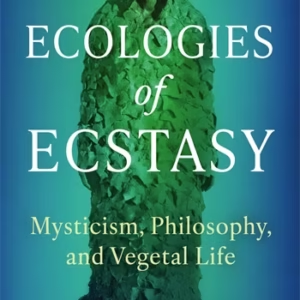
إيكولوجيا الابتهاج: العرفان، والفلسفة، وحياة النبات
إيكولوجيا الابتهاج: العرفان، والفلسفة، وحياة النبات
What can religious practices learn from plants? Recent years have seen the emergence of critical studies of plants, and philosophers have found a radical mode of thought in plant life. Ecstasy reframes religious meditation as a form of vegetative existence, arguing that spiritual practice is rooted in the origins of life on Earth. Simone Kotva explores the role of plant life in the history of Christian mysticism and the practice of meditation, demonstrating its importance to the concept of mystical union, which is based on the loss of the distinction between self and world. She shows that plants, animals, and other beings were once understood to exist thanks to meditation, and examines how traditional religious doctrines suppressed this idea. Ecstasy Environments offers new readings of the texts of figures such as Plotinus, Evagrius of Pontius, Hildegard of Albinos, Margaret of Puritan, the Helvetian mystics, and Jean Goyon, in light of contemporary philosophies of plant life and critical plant studies. The book combines feminist, heteronormative, and ecocritical readings of Christian mysticism with continental philosophy and the works of Michael Marder, Emanuel Coccia, and Luce Irigaray. By integrating Christian meditation with plant-based philosophies, this book offers new ways of understanding mysticism and spiritual practice.
Bibliographic Data
| Publisher | Columbia University Press |
|---|---|
| Publisher Address | ips@ingramcontent.com |
| Country | USA |
| Primary Category | Philosophies and Cultures |
| Language | Arabic (AR) |
| Translation | Translated |