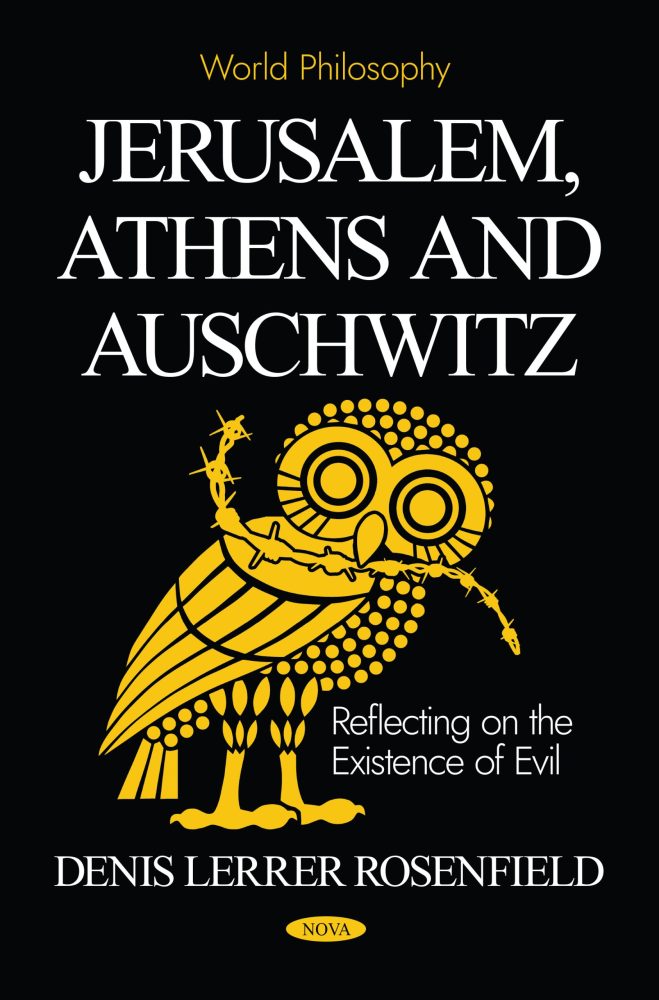
القدس، أثينا، وأوشفيتز: تأملات في وجود الشر
القدس، أثينا، وأوشفيتز: تأملات في وجود الشر
The book (Jerusalem, Athens, and Auschwitz: Reflections on the Existence of Evil) deals with the topic of fear and freedom from it. It is a wide-ranging book, exploring philosophy, theology, history, and politics, with the idea of evil as both background and organizing thread, drawing historically on Auschwitz as a symbol of a new form of death and evil. Not only death in its natural sense, but death in its political sense, especially in its comprehensive sense. Philosophically, the book is full of references to Hobbes and Hegel, with a special focus on Hegel's master-slave dialectic as presented in his book The Phenomenology of Spirit. Theologically, the book includes an extensive discussion with Jewish, Catholic, Protestant, and Evangelical thinkers, within the framework of the concept of evil as it arose and developed during and after the war. Among Jewish thinkers, emphasis is placed on Kabbalah, Maimonides, Moses Mendelssohn, Moses Hesse, Abraham Isaac Koke, Martin Buber, Franz Rosenzweig, Emil Fackenheim, Abraham J. Heschel, Elie Wiesel, Primo Levi, Hans Jonas, Gershom Scholem, Vladimir Yankelevitch, Emmanuel Levinas, Arthur Cohen, and Richard Rubinstein; Among the Catholics were Étienne Gilson, Gaston Vissar, Henri de Lubac, François Mauriac, Hans Urs von Balthazar, Gabriel Marcel, and Pope Pius XI; Protestants and evangelicals include Karl Barth, Paul Ricoeur, Mark Lindsay, Georg Hunsinger, Alice and Roy Eckhart, and Franklin Little. Politically, the discussion includes a reflection on the Nazi experience in Germany and France, and an analysis of the theories of a Nazi theorist such as Karl Schmitt, and an “executor” figure such as Himmler. Historically, Germany is considered a primary reference, focusing on the rise of Nazism and its totalitarian practices, and France during the occupation period, focusing on the “spiritual resistance” embodied by the Jesuits gathered in Lyon, as well as the role of the Jewish councils, especially the prominent moral figure Adam Czernyakov, the “mayor” of the Warsaw Ghetto.
Bibliographic Data
| Publisher | Nova Science Publishers |
|---|---|
| Publisher Address | support@novapublishers.com |
| Country | USA |
| Primary Category | Philosophies and Cultures |
| Language | Arabic (AR) |
| Translation | Translated |
| Keywords | الشر |