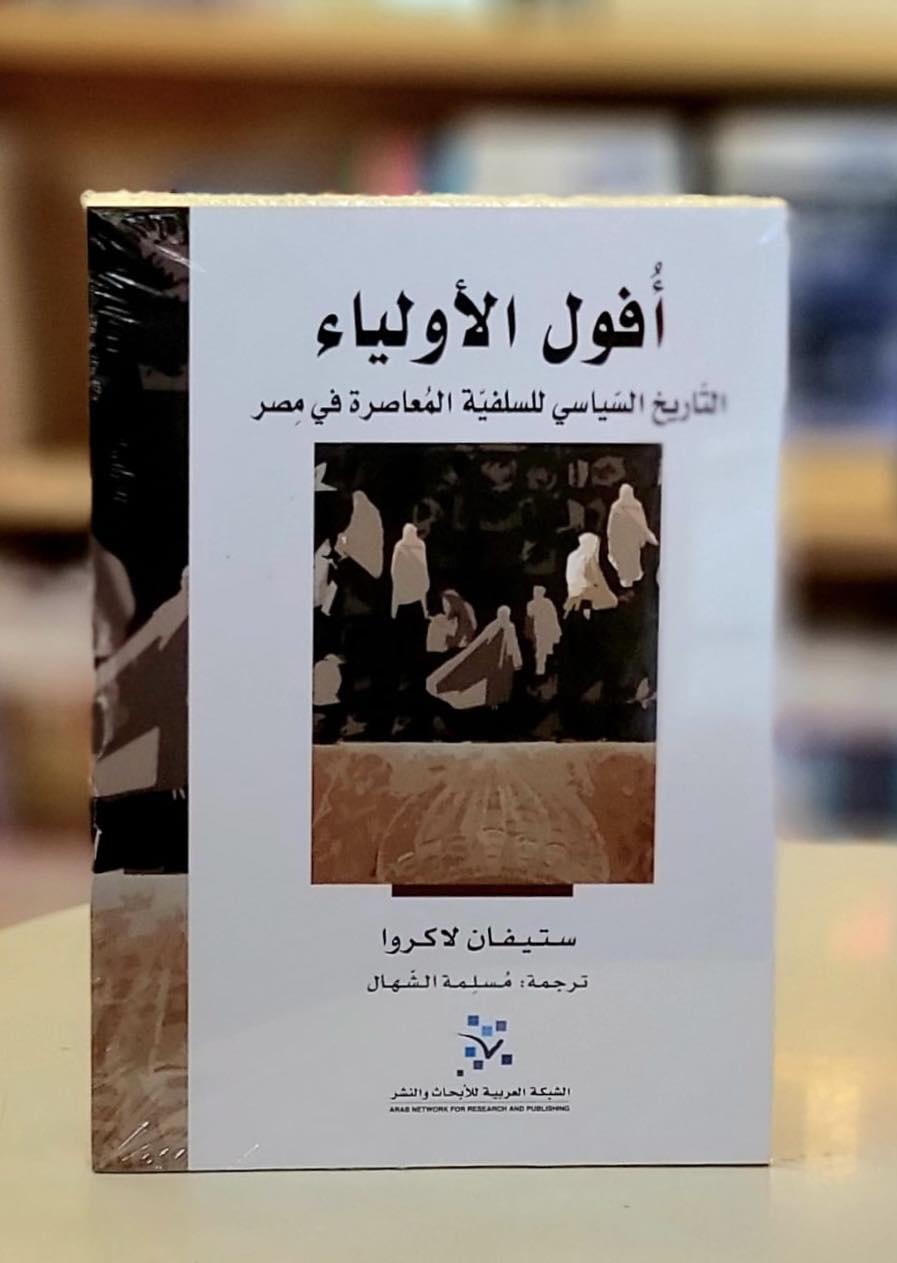
أُفول الأولياء: التاريخ السياسي للسلفية المُعاصرة في مصر
أُفول الأولياء: التاريخ السياسي للسلفية المُعاصرة في مصر
The book “The Decline of the Saints: The Political History of Contemporary Salafism in Egypt,” by French researcher Stephane Lacroix, was recently published by the Arab Network for Research and Publishing, translated from French by Muslim al-Shahhal. In this book, Dr. Stephane Lacroix, professor of politics at the Institute of Political Sciences in Paris (https://www.sciencespo.fr/en/), spent ten years preparing this important academic thesis, and conducted interviews with dozens of actors in the Egyptian Salafist scene. Lacroix divided the book into six chapters in which he retraced the beginning of the Salafist movement in Egypt and its history from the beginning of the twentieth century, through the era of Abdel Nasser. He then discussed its development into a “dawa” and the extent of its influence on the Kingdom of Saudi Arabia, then its remarkable prosperity and expansion during the Mubarak era. After that, the author moved on and devoted chapters to dealing with the position of the “Nour Party” in confronting the Brotherhood in the January 2011 revolution, finally arriving at the final chapter on revolutionary Salafism and the option of populism. The book examines the concept of Salafism, and how it gained influence to place itself at the heart of Sunni Islamic norms. What is its relationship to politics? Why should its developments be examined and distinguished from the Muslim Brotherhood? Among what was stated in his introduction: Stephane Lacroix invites us to uncover the answers to these questions in the social history of Egyptian Salafism. The complex Egyptian reality, due to the diversity of conflicting and conflicting intellectual currents over the right to chart the course of society and direct it, starting from the days of the Renaissance, then English colonialism, then the monarchy, and the Free Officers Revolution, to Arab nationalism, the Egyptian revolution, the fall of Mubarak, and what followed, are all reasons that prompted the author to conduct field research in Egypt, which is considered one of the strongholds of “traditional Sunni Islam,” and to track the Salafist movement and its actors, individuals and groups, and the transformations. What has changed, from being just an ideology adopted by a minority, to the most important influence and the most important central player after the Egyptian Revolution in 2011.
Bibliographic Data
| Publisher | Arab Network for Research and Publishing |
|---|---|
| Publisher Address | الشبكة العربية للأبحاث والنشر |
| Country | Lebanon |
| Also In | |
| Language | Arabic (AR) |
| Translation | Translated |