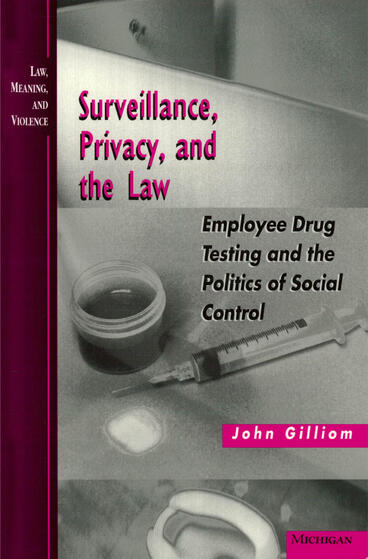
Surveillance, privacy and the law
المراقبة والخصوصية والقانون
Drug testing of employees is a controversial new policy, considered a blatant intrusion into the American work environment, and was popularized during the War on Drugs in the 1980s. Labor, judges, and politicians are divided over whether this testing is an unnecessary and unconstitutional surveillance program, or an effective and appropriate new weapon in the drug control arsenal. After the controversy subsided, this new technology was widely used, and received strong approval from the US Supreme Court. This raises a fundamental question: Why was the momentum behind this test strong, while opposition to it was weak? Drawing on theories of ideological hegemony and legal mobilization, John Gilliom begins the search for answers by examining how the image of the national drug crisis shaped the justification context for the introduction of this test. His book, Surveillance, Privacy, and the Law, then goes beyond the specific history of the test and places this new policy within the framework of a broader transformation of the politics of social control, as seen by students of political economy, society, and culture. The book cites survey research conducted among skilled workers and analyzes court opinions to highlight the sharp polarization of opinions in American workplaces and courts. Although federal court decisions show widespread and passionate disagreement among justices, the new conservative Supreme Court strongly supports drug testing. Its rule embraces surveillance technology, rejects arguments against testing, and undermines any future opposition to public surveillance policies. “Surveillance, Privacy, and the Law” portrays the apparent victory of testing policies as a victory for the conservative law-and-order movement, and a catastrophic loss for the values of privacy and autonomy. As one link in a broader shift toward a surveillance society, the battle over employee drug testing raises troubling questions about future struggles over revolutionary new means of surveillance and control. John Gilliom is a professor of political science at Ohio University.
Bibliographic Data
| Publisher | University of Michigan PressWebsite |
|---|---|
| Publisher Address | press.umich.edu Ann Arbor, Michigan, USA. 839 Greene Street, MI 48104-3209, um.press.perms@umich.edu. |
| Country | USA |
| Also In | |
| Published | 2025 |
| Language | Arabic (AR) |
| Pages | 192 pages |
| Edition | Second edition |
| Dimensions | figure 9 x 6 |
| ISBN | 9780472223626 |
| Translation | Translated |
| Keywords | المخدراتالمراقبة والخصوصية والقانون |