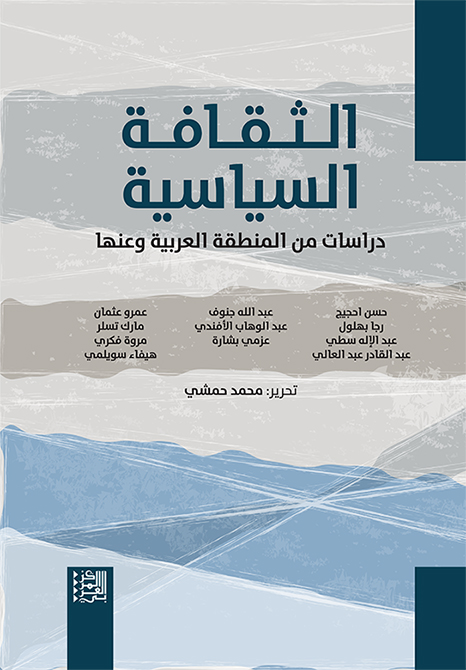
The Arab Center for Research and Policy Studies published the book Political Culture: Studies on and from the Arab Region. It is a collective work edited by Muhammad Hamshi. It includes an introduction and ten chapters, and is 423 pages long, including a bibliography and a general index. The book seeks to revive the study of political culture in the context of the Arab region as a scientific research, building on a broad tradition of literature, conceptual, theoretical, and empirical, and engaging with a set of questions that Arab contexts insist on asking researchers in the social sciences in general. In the first chapter, “Political Culture: General Observations,” Azmi Bishara provides a critical and reflective contribution to framing the debate on political culture, both conceptually and theoretically, both in the book’s chapters and outside of them. It represents an Arab intervention in the debate from outside the geocultural context in which the concept and theory of political culture developed. These observations are: the issue of civic culture, culture and the transition from attitudes to political behavior, the issue of public morality, cultural “theories” of democracy that emerged from alliance with dictatorships, political culture and slavery between Alexis de Tocqueville and Barrington Moore, political culture and the transition to democracy, and critics of culture and the struggle for democracy. In the second chapter, “Emotional Orientations and Democratic Political Culture,” Raja Bahloul starts from Gabriel Almond and Sydney Verba’s definition of political culture and their distinction between its cognitive, emotional, and evaluative components. He then presents a critical discussion of the traditional concept of political culture, demonstrating his failure to distinguish between the emotional and evaluative, and his neglect of the elements of desire and behavior in political culture. The chapter then addresses a re-examination of the concept of democratic political culture, and the emotional tendencies inherent in it. In the third chapter, “Challenges of Digital Social Networks to Classical Political Culture Theory,” Hassan Hajej addresses the challenges posed by the transformations of political culture in digital society to classical political culture theory. In the same context, Marwa Fikry and Amr Othman discuss in the fourth chapter, “Political Culture, the Internet, and the Paradox of Collective Memory: Lessons from the January 25, 2011 Revolution in Egypt,” the impact of the increasing use of the Internet on political culture, and the limits it imposes on the role of the state and the elite in shaping political culture and collective memory. Through a case study of the January 25 Revolution in Egypt, the chapter discusses how individuals remember the event, the values, symbols, and meanings that that remembrance entails, the extent of agreement or disagreement on the authority’s narrative (or narratives) of the event, and the significance of all of this with regard to the political culture of society in general, and the opportunities for “the growth of a culture of reconciliation in it in particular.” Not far from the case of Egypt, Abdel Wahab Al-Afandi discusses in Chapter Five, “Culture as a Weapon: Culture Wars and Culture Wars in the United States and Egypt,” the intersections between culture and political culture through a comparison between the cases of the United States of America and Egypt. After an extensive discussion of the concept of “culture wars,” interspersed with a comparison between the manifestations of culture wars in the American and Egyptian cases, Al-Afandi concludes, among other conclusions, that a single culture is not a guarantee of harmony, but rather may constitute a framework for violent rivalries due to competition and the feeling of threat by some components, especially in the context of rapid changes. In the American and Egyptian cases, the major transformations in the cultural systems themselves were an important factor in the political scene, and some of the tools for shaping it.
Genocidal Nightmares Narratives of Insecurity and the Logic of Mass Atrocities
الثقافة السياسية | دراسات عن المنطقة العربية ومنها
Not Translated
Listen to book
Bibliographic Data
| Author | |
|---|---|
| Publisher | Arab Center for Research and Policy Studies |
| Publisher Address | office@dohainstitute.edu.qa |
| Country | Qatar |
| Primary Category | Social Studies |
| Also In | |
| Published | 2025 |
| Language | Arabic (AR) |
| Pages | 423 pages |
| Edition | First edition |
| Dimensions | 17×24 |
| ISBN | 9786144456675 |
| Translation | Not Translated |