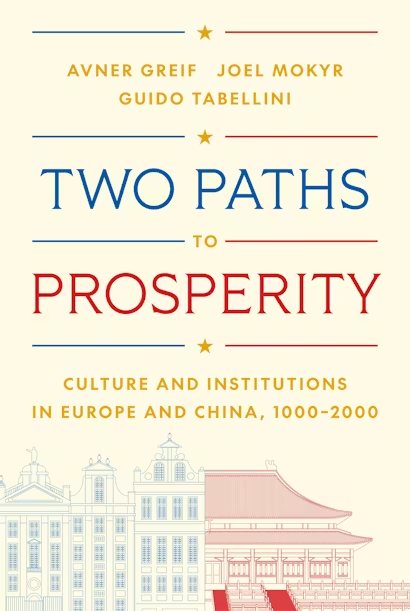
In the eleventh century, when Europe was still backward and poor, China was a rich and sophisticated civilization. Yet Europe became the birthplace of democracy and the Industrial Revolution, driving the Great Enrichment, while China stagnated until the end of the twentieth century and was always ruled by autocracies. Two Paths to Prosperity traces the emergence of two very different social organizations in premodern China and Europe—the clan and the corporation—showing how they were key factors in the economic and political divergence of these two great civilizations. In this landmark book, three leading economists offer a bold new account of why Europe and China evolved along such different trajectories. In the early Middle Ages, public goods like risk sharing, religious worship, education, and conflict resolution were provided by nonstate organizations in both societies. China increasingly relied on kin-based cooperation within clans, while weaker kinship ties in Europe gave rise to corporations such as guilds, universities, and self-governing towns. Despite performing similar functions, clans and corporations were built on very different principles—with lasting consequences until today.
Two Paths to Prosperity: Culture and Institutions in Europe and China, 1000–2000
طريقان نحو الازدهار: الثقافة والمؤسسات في أوروبا والصين، 1000-2000
Not Translated
Listen to book
Bibliographic Data
| Author | |
|---|---|
| Publisher | Island PressWebsite |
| Publisher Address | info@press.princeton.edu |
| Country | USA |
| Primary Category | Ideas and Policies |
| Also In | |
| Published | 2025 |
| Language | English (EN) |
| Pages | 544 pages |
| Edition | first |
| Dimensions | 6×9 |
| ISBN | 9780691265940 |
| Translation | Not Translated |