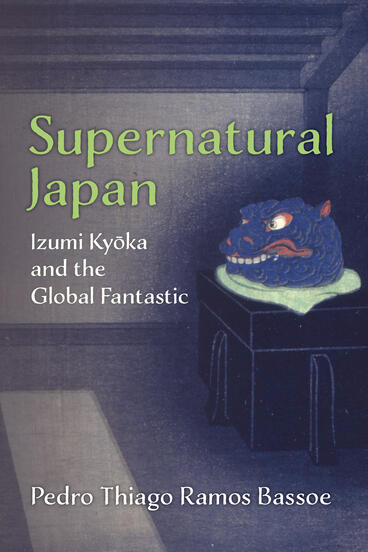
Supernatural Japan examines the role of Japanese writer Izumi Kyōka (1873–1939) in the formation of modern literature of the fantastic in Japan as a global literary genre. Kyōka wrote some of the most famous stories of ghosts, monsters, and the supernatural in modern Japanese literature, including The Holy Man of Mt. Kōya, The Grass Labyrinth, and The Castle Tower. Despite the clearly modernist elements and global influences of Kyōka’s fiction, his work has often been characterized as relying on traditional Japanese genres as inspiration for its themes and literary form.
Pedro Bassoe considers how Kyōka’s stories have been produced by a meeting of global influences—including Apuleius, The Arabian Nights, Hans Christian Andersen, the Brothers Grimm, Prosper Mérimée, Guy de Maupassant, Gerhart Hauptmann, and Jules Verne—combined with traditional Japanese genres. Bassoe develops the notion of “the scholarly fantastic” to describe how a set of realistic epistemologies reinforce the fantastic in Kyōka’s writings. Supernatural Japan offers an up-to-date introduction to Izumi Kyōka and his writing for students, scholars, or fans of Japanese fantasy literature and media.