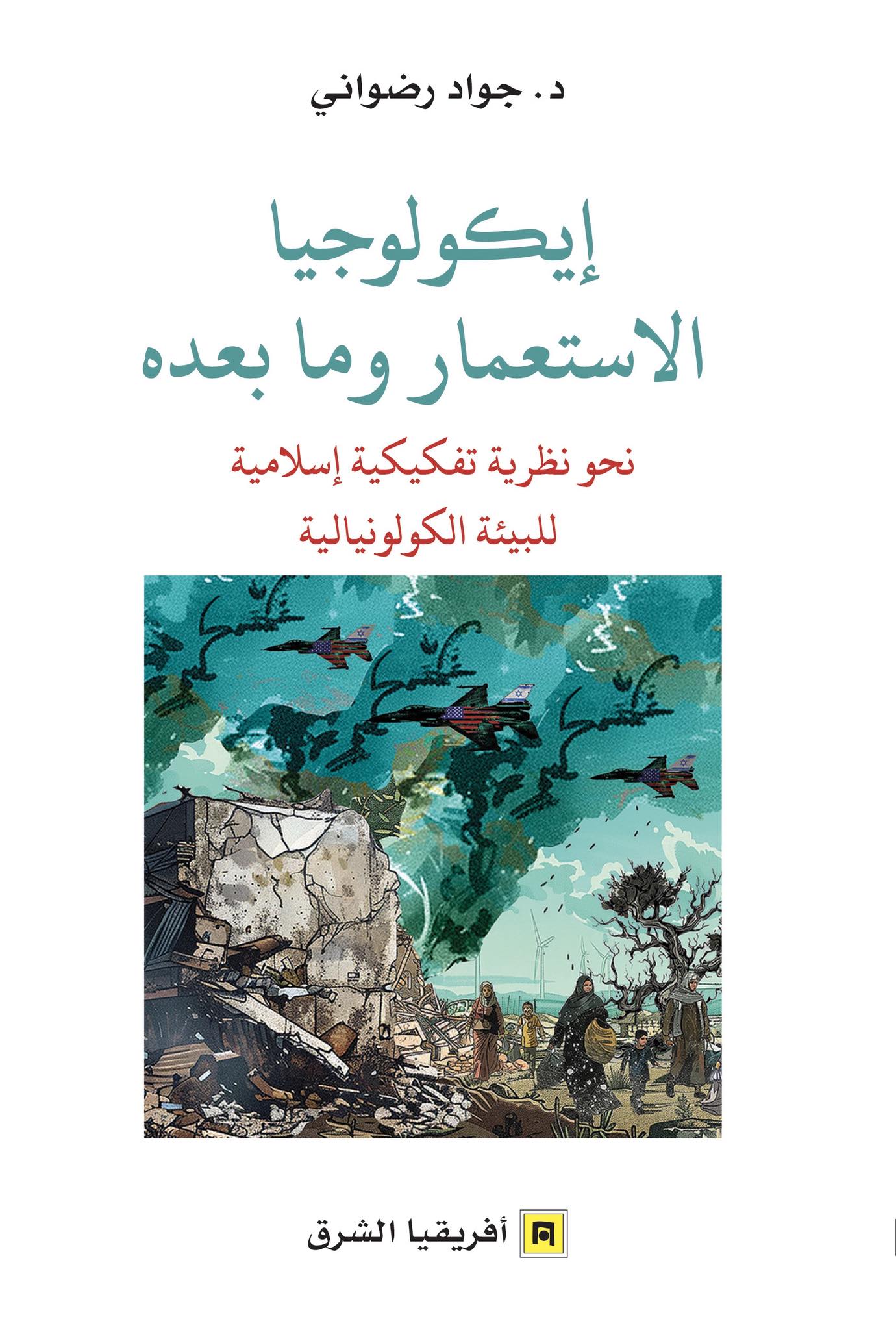
إيكولوجيا الاستعمار وما بعده.. نحو نظرية تفكيكية إسلامية للبيئة الكولونيالية
إيكولوجيا الاستعمار وما بعده.. نحو نظرية تفكيكية إسلامية للبيئة الكولونيالية
The author of the book: (The Ecology of Colonialism and its Aftermath...Towards an Islamic Deconstructive Theory of the Colonial Environment) seeks to establish a different perception regarding the meaning and concept of colonialism. Colonialism. It, along with the demand to create the kind of broader and more comprehensive understanding that it attempts to present and present, remains an attempt to explain, interpret, and deconstruct colonialism as an idea and theory. As a study and research, it rereads colonial thought and history in order to determine, with a high degree of clarity, the source of colonial “cultures,” understand their goals and motives, and explain how they operate. It is, more expressively, an excavation of the colonial essence for the sake of purely “deconstructive” goals and objectives. Accordingly, the author highlights, as an intentional and meaningful challenge in itself, extremist colonial thought in particular, in addition to focusing on the colonial intellectual structure in terms of it being a pre-condition that advances the actual implementation of any project of domination and colonialism. Therefore, the aim of this book, in general, is to provide a modern theoretical interpretation of colonial “thought” as perception, culture, and conviction. Since the colonial phenomenon is an idea, before any attempt is made to implement it, reviewing its origins that emerge from it and from it remains, at least for this project, the ideal method for leading any attempt whose goal is not only to understand the sources of “colonial theory” and determine the degree of its deviation from the general moral indicator, but also to establish forms of intellectual and cultural resistance capable of demolishing the corrupt origins that provide all forms of tyranny with the necessary means of existence for survival and continuity. Correct, I apologize for the confusion in the name. The book is “The Ecology of Colonialism and its Aftermath: Towards an Islamic Deconstructive Theory of the Colonial Environment” by Moroccan researcher Jawad Radwani, and it was published by Dar Africa East. This book is considered a breakthrough in contemporary Arab studies because it connects three fields that rarely come together: (postcolonial studies, environmental philosophy, and the Islamic perspective). The essence of what Jawad Radwani presents in the book: 1. Criticism of “Western ecocentrism”: The researcher believes that Western thought (even in its environmental version) still views nature with a colonial eye, where man is separated from his surroundings and the earth is transformed into a “material for control.” 2. Colonialism as an environmental crime: Analyzes how colonialism not only enslaved humans, but also “colonized the soil” and changed the environmental features of the colonies to serve the imperial economy, which some call “ecocide.” 3. Islamic deconstructive tool: Rezvani does not present Islam as a ritual, but rather as a cognitive framework (paradigm). He uses concepts such as “monotheism” and “balance” to deconstruct the hierarchical relationship that modernists established between man and nature, arguing that reclaiming sovereignty over the land begins with reclaiming original cultural concepts. 4. Criticism of Liquid Modernity: Links environmental degradation with consumer patterns imposed by globalization, considering it an extension of the “colonial mentality.” The book is a solid academic work that attempts to move Islamic thought out of the circle of “traditional jurisprudence” and into the circle of “global philosophical criticism.” Do you want to focus on a specific chapter (such as his criticism of technology or modernity) or do you want to know the intellectual sources that Rezvani relied on in building his theory?
Bibliographic Data
| Author | |
|---|---|
| Publisher | AfriqueOrient |
| Publisher Address | africorient@yahoo.fr |
| Country | Morocco |
| Primary Category | Ideas and Policies |
| Language | Arabic (AR) |
| Pages | 240 pages |
| Edition | الأولى |
| Dimensions | 17×24 |
| ISBN | 9789920677271 |
| Translation | Not Translated |