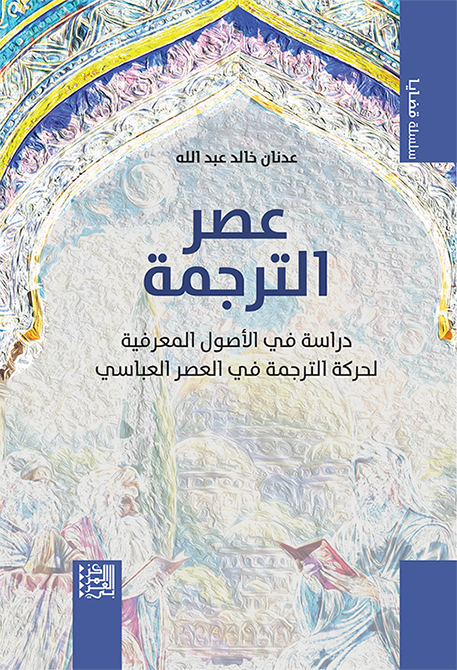
The Arab Center for Research and Policy Studies published the book The Age of Translation: A study of the cognitive foundations of the translation movement in the Abbasid era, written by Adnan Khaled Abdullah, and is 299 pages, Including an executive summary, a critical introduction, nine chapters, a conclusion, appendices, references, and a general index. The book reviews the major translation movement in the Abbasid era (800-1150 AD), as a highly complex cognitive and social phenomenon that shaped the features of Arab and Islamic thought for three centuries. In its beginnings, the Abbasids focused on translating utilitarian sciences, such as medicine and engineering, but they soon opened up to theoretical knowledge such as logic, philosophy, astrology, etc., and this reflected the state’s transition from the practical need to comprehensive civilizational interaction. The book examines the deep motives that fueled this movement, and the far-reaching effects it left on the structure of thought, religion, and society. ## Translation in the Abbasid Era: A Cultural, Not a Linguistic Act The book deals with the roots of the translation movement in the Abbasid Era, and its cognitive, political and religious contexts, in order to highlight the cultural face of a civilization that drew from the other and did not dissolve in it, but rather shaped it in its own image and included it in its vital fabric. Although translation appears to be a purely linguistic act on the surface, in essence it is a complex process, in which the linguistic intersects with the religious, the political with the philosophical, and the aesthetic with the social, so that the translator is no longer a simple transmitter, but rather a cultural actor who reproduces meaning within a different context. The author was aware of this, so he delved into the details of the Abbasid experience in translation, investigating its motives, and trying to decipher the transformation that occurred in the Arab mind when it encountered foreign knowledge, especially Persian and Greek, and began to digest it, then reshape it in his own style, until it became part of its intrinsic component, not an appendage to it. ## Translation and Intellectual and Political Conflicts: From Populism to the Plight of the Creation of the Qur’an The book reveals the features of a mature cultural experience, in which translation had a pivotal role in the emergence and prosperity of the sciences, but it was not isolated from intellectual, religious and political controversy. Rather, it came within heated conflicts, such as the populism that the Persians raised in response to the dominance of the Arabs, and the heresy that spread under the pretext of openness to non-Islamic laws, leading to the plight of the creation of the Qur’an that The Mu'tazila under the leadership of Caliph al-Ma'mun exploded it, and made the state a sponsor of an intellectual doctrine that did not accept anyone who disagreed. If some of these conflicts were accidental, they were ultimately a direct result of the translation movement itself. Because it posed new questions to the Arab mind, and forced it to deal with knowledge it was not familiar with before. Thus, translation was not merely a process of transfer, but rather became a catalyst for debate and a starting point for rebuilding perceptions and cognitive foundations.
The Age of Translation: A study of the cognitive origins of the translation movement in the Abbasid era
عصر الترجمة: دراسة في الأصول المعرفية لحركة الترجمة في العصر العباسي
Translated
Listen to book
Bibliographic Data
| Author | |
|---|---|
| Publisher | Arab Center for Research and Policy Studies |
| Publisher Address | office@dohainstitute.edu.qa |
| Country | Qatar |
| Primary Category | Languages and Literature |
| Also In | |
| Published | 2025 |
| Language | Arabic (AR) |
| Pages | 304 pages |
| Edition | First edition |
| Dimensions | 22.5*15.5 |
| ISBN | 9786144456767 |
| Translation | Translated |
| Keywords | الترجمةعدنان خالد عبد الله |