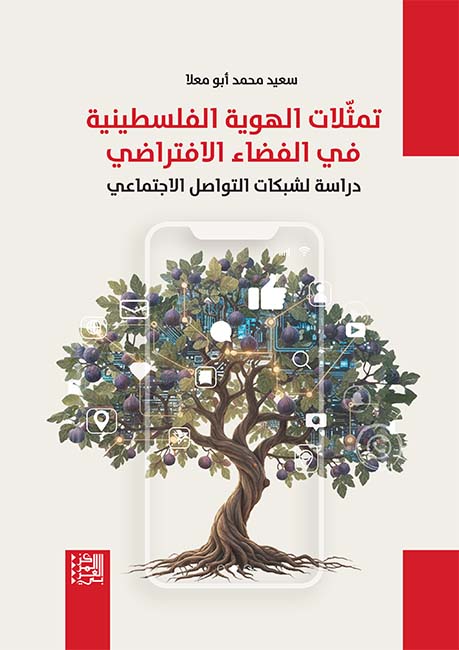
The Arab Center for Research and Policy Studies published the book **Representations of Palestinian Identity in the Virtual Space: A Study of Social Networks**, written by Saeed Muhammad Abu Mualla, as part of a series of publications. It is composed of five chapters and includes a general index. The book presents a scientific approach that seeks to understand how Palestinians use social media networks, especially the Facebook (Meta) platform, as a virtual public space in which they regain their national presence and through which they build various layers of their identity, despite their distant locations and geographical dispersion. It is based on the premise that political transformations, the faltering national project, and the blockage of the horizon of statehood have prompted Palestinians to create alternative worlds within the digital environment, in which they practice new forms of appearance, interaction, and individual and collective self-expression. The book believes that the Palestinian identity, which is sometimes thought to be fixed and specific, is in fact an identity that is constantly exposed to the effects of politics, occupation, and alienation, and to the huge differences between the environments in which Palestinians live, whether in the homeland or in the diaspora. With the expansion of the use of virtual space, Palestinians have a unique opportunity to transcend the limits imposed by fragmentation. Digital platforms have become a space for reformulating their identities, restoring their narratives, and reconnecting what was cut off between them over time and distance. The book relies on the elements of classical identity, represented by the land, the people, and the story, based on the theory of public space and the virtual counter-public space, and taking the aesthetic approach as a tool for analyzing digital interaction as a form of meaning production. It covered a wide range of digital models that represent multiple Palestinian segments: news pages in the West Bank, Gaza, and Jerusalem, and pages for the Palestinians of the occupied interior in 1948, in addition to other pages and groups representing refugees in Lebanon, and interactive groups such as “Telling the Villages,” and Tariq Bakri’s “We Were and Still” page, which recalls collective memory. The book shows that digital platforms have provided Palestinians with an alternative space to embody their identity, far from the monopoly of traditional political institutions to represent it. These platforms have produced more diverse and flexible representations that accommodate different political environments and give Palestinians the ability to build parallel identities that are adjacent to one another without any exclusion between them. Despite theories that globalization and post-modernism have made national identities fluid and fragmented, the Palestinian case seemed to contradict this. Digitization contributed to strengthening national representations, rather than weakening them, as a result of the feeling of uprooting and the occupation’s attempts to erase identity.
Representations of Palestinian identity in virtual space
تمثلات الهوية الفلسطينية في الفضاء الافتراضي
Translated
Listen to book
Bibliographic Data
| Author | |
|---|---|
| Publisher | Arab Center for Research and Policy Studies |
| Publisher Address | office@dohainstitute.edu.qa |
| Country | Qatar |
| Primary Category | Ideas and Policies |
| Published | 2025 |
| Language | Arabic (AR) |
| Pages | 367 pages |
| Edition | First edition |
| Dimensions | 24*17 |
| ISBN | 9786144457122 |
| Translation | Translated |
| Keywords | تمثلات الهوية الفلسطينية في الفضاء الافتراضي |