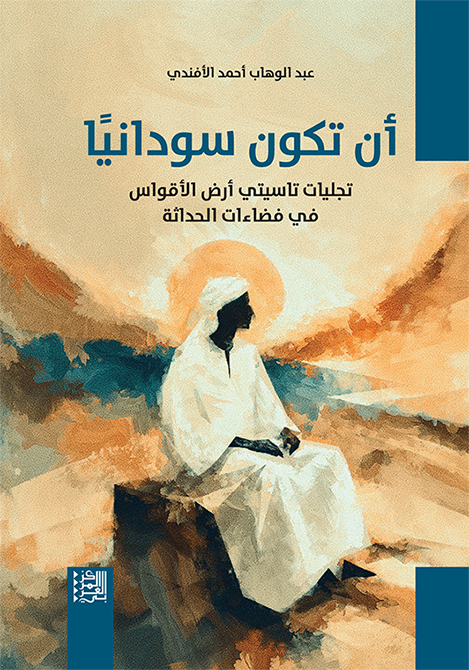
The Arab Center for Research and Policy Studies published the book To Be Sudanese: Manifestations of Taseti, the Land of Bows in the Spaces of Modernity, written by Abdul Wahab Ahmed Al-Afandi, It contains 568 pages. The book provides a radical treatment of an issue that has preoccupied public opinion in Sudan and the world, and because of which blood has been shed, and the country has been exposed to widespread unrest, which is the issue of Sudanese identity. He presents a new perspective on this issue, rereading it in light of its historical depth on the one hand, and tracing, on the other hand, its manifestations in contemporary debates, especially in the writings of a number of Sudanese who had a noticeable influence (or sought to have an influence) on the developments of national identity and its paths over the past decades. The summary of the book's arguments can be summarized in one sentence, which is that current Sudan is essentially an Arabic-speaking Nubian entity, as the product of a civilization with deep roots in its land and history. The basic hypothesis is that Sudanese civilization, which is one of the oldest civilizations in the world, is distinguished by the peculiarity of its internal development and the independence of its historical path from other civilizations. Unlike the major civilizations that were contemporaneous (from Rome and Greece, to Egypt and Mesopotamia, then India and China, with partial exceptions), Sudanese civilization was not subjected to widespread invasions by “barbarian” forces or competing civilizations. It was able to repel most of the invasion attempts, including the influences of neighboring Egypt, although it re-represented the Egyptian civilization in its own way. Rather, it contributed to protecting Egypt and its civilization at a critical historical moment, in the seventh century BC, and later went through the influences of the Greeks, Romans, and Persians who ruled Egypt, and then the Muslim Arabs. On the other hand, it interacted with its cultural surroundings. It benefited from Greek thought during the Ptolemaic era, and then voluntarily embraced Christianity (there is evidence that Christianity reached it directly before Rome and even some areas of Palestine). The Nubian civilization voluntarily accepted Islam after repelling the Islamic conquest with its famous arches, and it was the first civilization in the world to conclude a peace agreement with the Islamic Caliphate. Accordingly, the Sudanese identity was formed primarily through internal dynamics, not as some contemporary perceptions suggest, which attribute it to invasion or coercion, and the associated illusions related to inferiority or infatuation with the oppressive outside. It is true that all identities are built on myths and narratives that are not devoid of imagination, and this is common even in modernity contexts, but it is the existing identity that chooses its myths.
Being Sudanese: Manifestations of Tassiti, the land of arches, in the spaces of modernity
أن تكون سودانيًّا: تجليات تاسيتي أرض الأقواس في فضاءات الحداثة
Translated
Listen to book
Bibliographic Data
| Publisher | Arab Center for Research and Policy Studies |
|---|---|
| Publisher Address | office@dohainstitute.edu.qa |
| Country | Qatar |
| Primary Category | Ideas and Policies |
| Also In | |
| Published | 2026 |
| Language | Arabic (AR) |
| Pages | 568 pages |
| Edition | First edition |
| Dimensions | 17×24 |
| ISBN | 9786144457306 |
| Translation | Translated |