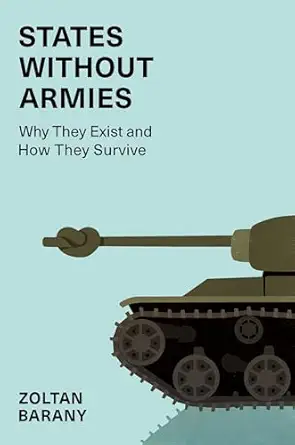
دول بلا جيوش
دول بلا جيوش
A basic assumption about the modern state is that it must have the ability to defend itself against external enemies. However, today twenty-one countries - the equivalent of nine United Nations members - do not have standing armies. What historical contexts, geographic resources, or social and economic conditions allow or even encourage a country to dispense with a military? When does a country decide _not_ to have an army, and under what circumstances is this discussed? What security guarantees, if any, do states considering disarmament seek before making such a decision? What are the disadvantages and advantages of not having a regular army? Zoltan Baranyi addresses all these questions and more through three main arguments. First, it shows that the question of creating a new army or dissolving an existing force often arises at crucial historical junctures for the nation. This may occur following a civil war, a military coup, or an economic collapse. Second, almost all states without standing armies have formal or informal security arrangements that provide explicit guarantees or implicit assurances of the protection of their sovereignty. Third, demilitarized states are generally more democratic and better off—and often much better—in terms of political stability and almost every measurable variable of social and economic well-being than comparable states with standing armies. "States Without Armies" sheds new and unexpected light on the role of power in the international system of states.
Bibliographic Data
| Publisher | Oxford University Press واحدة من أقوى دور النشر في العالم |
|---|---|
| Publisher Address | info@global.com |
| Country | USA |
| Primary Category | Ideas and Policies |
| Also In | |
| Language | Arabic (AR) |
| Translation | Translated |