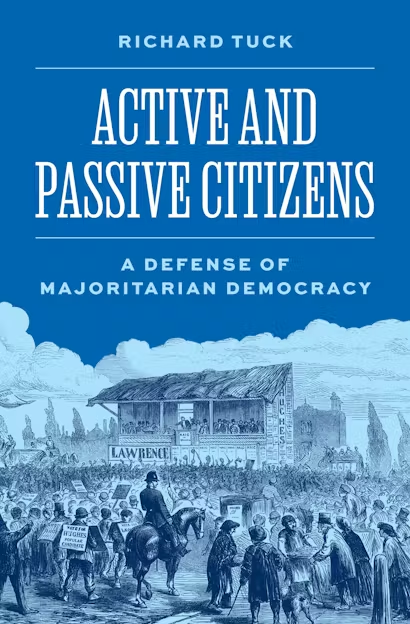
المواطن الإيجابي والمواطن السلبي: دفاع عن الديمقراطية القائمة على حكم الأغلبية
المواطن الإيجابي والمواطن السلبي: دفاع عن الديمقراطية القائمة على حكم الأغلبية
A powerful argument for why majority rule - not representation - is the hallmark of democratic politics. The idea that democratic government is based on the effective self-government of citizens receives little attention in contemporary democratic theories, which instead stress the importance of representation through elected, appointed, or randomly selected bodies, such as legislatures, courts, and juries. This would have surprised eighteenth-century theorists of democracy, who viewed universal suffrage and majority voting as the only criteria for democratic politics. Active and Passive Citizens defends the view of these earlier thinkers, asserting that individual agency is the essence of democracy. In this controversial and well-argued book, Richard Tuck builds on the distinction made by Abbé Sieyès, one of the most prominent political theorists of the French Revolution, between “active” citizens (voters) and “passive” citizens (those represented by state institutions). Tack traces our current representative concept of democracy back to Sieyès, and compares it to Rousseau, the theorist of effective self-government of the people. Tuck argues that modern theories of democracy have effectively turned us into passive citizens, and calls for a renewal of majority-based democracy to realize the full potential of active citizenship. Active and Passive Citizens is based on the prestigious Tanner Lectures at the Center for Human Values at Princeton University, edited and presented by Stephen Macedo, and includes commentary from political theorists Simon Chambers, Joshua Cohen, John Vergon, and Melissa Schwartzberg.
Bibliographic Data
| Publisher | Island PressWebsite |
|---|---|
| Publisher Address | info@press.princeton.edu |
| Country | USA |
| Primary Category | Ideas and Policies |
| Language | Arabic (AR) |
| Translation | Translated |