جرسونيدس يقتحم القرن الحادي والعشرين: "حروب الرب" في طبعة فرنسية تعيد قراءة الصدام بين العقل والنص
جرسونيدس يقتحم القرن الحادي والعشرين: "حروب الرب" في طبعة فرنسية تعيد قراءة الصدام بين العقل والنص
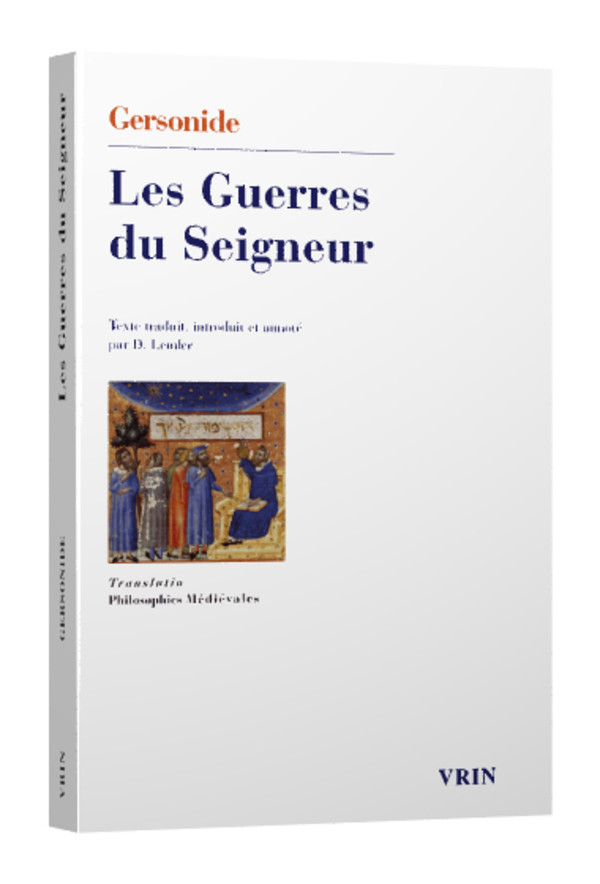
In the spring of 2026, the academic and philosophical circles are preparing to receive an exceptional intellectual event, as the prestigious “Vrin” publishing house, in its famous “Translatio” series, announces the publication of a new and revised French translation of essential parts of the book “The Wars of God” (Les Guerres du Seigneur) by the Jewish philosopher, logician, and astronomer, “Livy Ben Gershom,” known as “Gersonides” (1288-1344). This edition does not come as a mere restoration of an ancient text, but rather as a reconsideration of one of the boldest minds of the Middle Ages, the man who dared to stand in the gray area between Aristotle and Maimonides, trying to decode existence with the tools of pure science. ## The philosopher who rebelled against the “thumb” Gersonides, who lived and was active in the “Provence” region of France, is considered both the legitimate heir and a fierce critic of the Peripatetic (Aristotelian) tradition as formulated by Ibn Rushd. At a time when philosophers tended to “esoteric writing” (esoteric or occult) to protect themselves from the public or to hide the conflict of reason with transmission, Gersonides stands out as an advocate of scientific transparency. In this book, Gersonides rejects the “coding” approach followed by Maimonides in his book “The Meaning of the Perplexed.” He believes that philosophical truth must be presented with mathematical clarity, believing that the human mind is capable of understanding the most complex metaphysical issues without the need to hide behind metaphors. ## A reading of the structure of the book: From Introduction to Creation. This new edition, translated by “David Lemmler,” is distinguished by its focus on crucial joints in Gersonides’ thought: ## 1\. The Conflict of the Introductions (Gersonides vs. Maimonides) The book includes an unprecedented translation of Gersonides' introduction, which he penned as a direct response to the introduction to the Semantics of the Perplexed. While Maimonides attempted to reconcile the Torah with Aristotle through symbolic interpretation, Gersonides insisted that philosophy was the criterion of truth, and that religious text should be understood in light of conclusive scientific proof. The book's introduction presents a "parallel history" of Jewish philosophy by comparing the introductions to major works, revealing shifts in philosophical consciousness across the ages. ##2\. The Dilemma of Creation and Eternal Matter (Book Six) The most controversial part of the book is the selected excerpts from Book Six. Here Gersonides presents his famous thesis with a “Platonist” tinge about the creation of the world. In contrast to the traditional position (creation from nothing) and the Aristotelian position (the eternity of the world), Gersonides offers a third way: the world was created in time, but it was created from “hypostatic matter” (primary matter) that existed eternally in a chaotic and formless form. For Gersonides, God did not create matter out of nothing, but rather endowed “order” and “form” to matter that lacked ordered existence. This vision was not just an intellectual luxury, but rather an attempt to resolve the logical contradictions facing natural philosophers at that time. ## Historical context: Ibn Rushd’s imprint and the Provençal environment Gersonides lived in a unique cultural environment; Provence was a bridge between Arab-Islamic thought and Latin Europe. His influence on Ibn Rushd's explanations on Aristotle was so profound that some consider him a "Jewish Rushdie." But Gersonides' advantage lies in his independence; He was a brilliant astronomer (he invented Jacob's rod for astronomical measurement), which gave his philosophy an experimental tone that was rare for his time. The book "The Wars of God" is, in essence, an intellectual battle against ignorance, and against interpretations that place limits on the human mind. The title itself is inspired by a biblical text, but according to Gersonides it turns to “wars of the mind” to prove existential truths. ## Why do we read Gersonides in 2026? The importance of publishing this book in the “Translatio” series comes from several angles: - Linguistic accuracy: Billingwall edition (Hebrew-French), which allows researchers to return to the original term and compare it with the modern translation. - Rereading the Medieval Times: The book breaks the stereotype of the Middle Ages as an era of blind faith, and shows it as an era in which systematic conflict was at its most intense. - Philosophical currentism: In the “post-truth” era, Gersonides’ call for a scientific approach and intellectual clarity seems more urgent than ever. The book "The Wars of God" in its new edition is not just a relic of the past, but rather a document chronicling the victory of rationalism. Gersonides, the philosopher who has long remained in the shadow of Maimonides, comes out today to declare that philosophy does not fear clarity, and that the true “wars of God” are those that are fought with the tools of logic and proof. With the publication of this work, a new page is opened in the study of comparative philosophy, and the contemporary reader is given a unique opportunity to sit with a mind that has not accepted compromises between what he sees and what he believes.
Bibliographic Data
| Publisher | philosophique J. VrinWebsite |
|---|---|
| Publisher Address | contact@vrin.fr |
| Country | France |
| Primary Category | Ideas and Policies |
| Also In | |
| Language | Arabic (AR) |
| Translation | Translated |