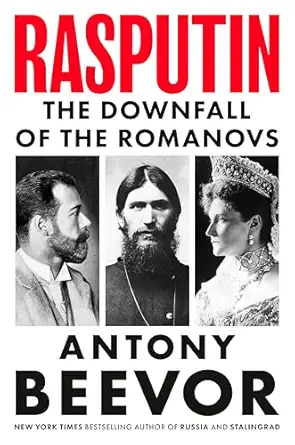
راسبوتين: سقوط آل رومانوف
راسبوتين: سقوط آل رومانوف
A huge library of books was published about this Rasputin, some of them historical and political, including biographies and novels, including films and plays, all of which attempted to explain the precise role that Rasputin played, intentionally or unintentionally, in overthrowing tsarist rule in Russia. This trend is still continuing, and the most recent headline is a recently published book entitled “Rasputin: The Fall of the Romanovs” by the distinguished British writer and historian Sir Antony Beevor: “My fascination with Rasputin goes back a long time, even before I began researching my previous book. (Russia: Revolution and Civil War), so how could an almost illiterate peasant from Siberia have such a devastating influence on the course of history? Although he had no official position, no troops under his command, and was a loyal supporter of imperial rule, he was not a revolutionary, but he unwittingly contributed more than any single individual to the collapse of the greatest tyranny in the world. The poet Alexander Blok, a member of the Extraordinary Commission to investigate the case after the February Revolution of 1917, wrote that “this person, whoever he was.” Whoever he was, he enjoyed enormous influence. He lived his days in a unique atmosphere in which he was the subject of hysterical admiration and constant hatred, as some worshiped him while others sought to destroy him. The secret of the uniqueness of this dissolute peasant who was killed by a bullet that hit his back at a “party with the gramophone” in Yusupov’s house lies in the fact that the bullet that killed him truly lodged in the heart of the ruling family.” However, Beevor asserts that “this striking image of the bullet that destroyed the tsarist regime is a gross reduction, because the fatal wounds were cumulative.”
Bibliographic Data
| Publisher | Penguin Random House Editorial GroupWebsite |
|---|---|
| Publisher Address | Penguin Publishing Group |
| Country | Spain |
| Primary Category | Ideas and Policies |
| Language | Arabic (AR) |
| Translation | Translated |