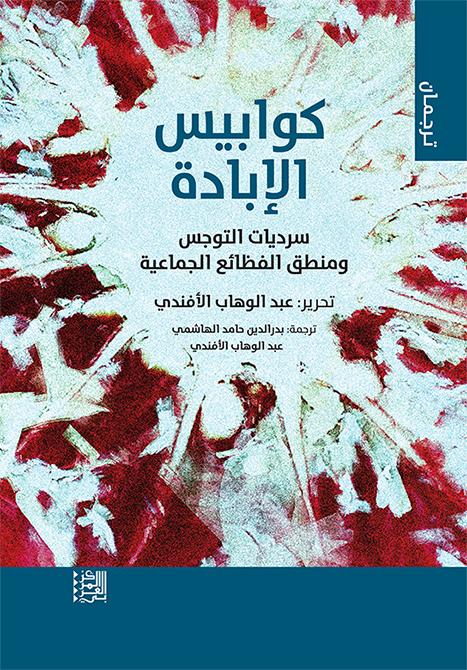
The Arab Center for Research and Policy Studies published the book Nightmares of Genocide: Narratives of Apprehension and the Logic of Mass Atrocities Genocidal Nightmares: Narratives ofInsecurity and the Logic of Mass Atrocities, within the Tarjuman series, edited by Abd al-Wahab al-Afandi and translated with Badr al-Din Hamid al-Hashimi, and is 448 pages, including an introduction to the editor’s Arabic translation, an introduction, concluding notes, and a general index, in addition to a list of tables, figures, and pictures. The editor has included tables, figures, and pictures in the body of the book, instead of including them in appendices at the end. The book discusses the phenomena of intense and escalating violence, and presents a new approach to understanding the motivations of “ordinary” individuals to engage in acts of extremist violence, arguing that narratives of insecurity play a pivotal role in making these actions justified or heroic. It combines theoretical explanation with case studies from four continents, representing a qualitative breakthrough in the field of studying collective violence. Francis Deng, former Special Adviser to the UN Secretary-General on the Prevention of Genocide, presented it, praising its scientific value. In his introduction to the Arabic translation of the book, the editor sees what is happening in Gaza today as confirmation of this interpretive framework. The “genocide nightmares” and narratives of terror gained a new dimension when the Israeli government presented the October 7, 2023 attack by Hamas as the greatest threat to Israel’s existence, thus justifying the actual genocide it is committing in Gaza today. ## The roots of research and the political context after September 11. The book stems from the long research experience of the editor, Abdul Wahab Al-Afandi, which began before the events of September 11, and which deals with the phenomena of unbridled violence, while linking them to the concepts of democracy and political Islam. The matter developed to include academic research at the University of Westminster, amid the increasing linkage of Islam with terrorism, and concluded with a central hypothesis that “narratives of apprehension and fear” are the primary driver of intense acts of violence, whether from states, groups, or individuals, as these narratives are based on creating an imagined danger or exaggerating a real danger, often based on identity, which leads to a self-reinforcing cycle of violence. The contributions of the co-authors in this book address the application of the interpretive model to many cases, such as: the Palestinian-Israeli conflict, the wars in Yugoslavia, the conflicts in Sudan, Nigeria, and India, and the rise of Islamophobia in the West. The book shows that intellectual, political, and media elites play a fundamental role in producing these narratives. ## A new theoretical framework: Excessive securitization and uncontrolled violence. The author relied on the “Securitization Theory” from the Copenhagen School, and added the concept of “excessive securitization” as a major driver of uncontrolled violence, such as war crimes and genocide. He stressed that these narratives are also used to disrupt the democratic transition, not only in Arab countries, but also in Western democracies. He concluded by opening the way for criticism of the hypothesis, calling on researchers to test it by trying to find cases of violence that are not explained by narratives of apprehension.
Nightmares of annihilation: Narratives of apprehension and the logic of mass atrocities
كوابيس الإبادة: سرديات التوجس ومنطق الفظائع الجماعية
Translated
Listen to book
Bibliographic Data
| Publisher | Arab Center for Research and Policy Studies |
|---|---|
| Publisher Address | office@dohainstitute.edu.qa |
| Country | Qatar |
| Primary Category | Ideas and Policies |
| Also In | |
| Published | 2025 |
| Language | Arabic (AR) |
| Pages | 448 pages |
| Edition | First edition |
| Dimensions | 14×24 |
| ISBN | 9786144456620 |
| Translation | Translated |