
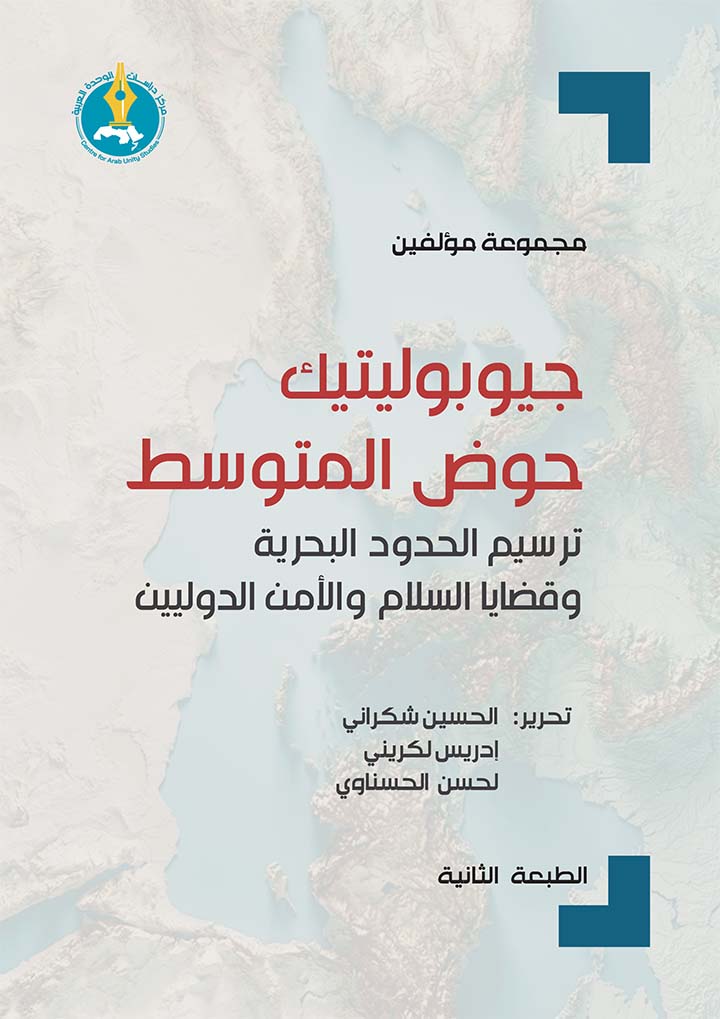
The Center for Arab Unity Studies issued the second edition of the book Geopolitics of the Mediterranean Basin: Demarcation of Maritime Boundaries and Issues of Peace and Security International By a group of authors (edited by: Al-Hussein Shukrani, Idris Lakrini, and Hassan Al-Hasnawi). The Mediterranean basin occupies an exceptional strategic position on the global level. It represents a land and sea meeting point for the three continents of Asia, Africa, and Europe, and a point of communication between the East and West of the Earth through the connection between the Atlantic and Indian Oceans. It is on the shores of about 24 countries and political, human, and cultural entities, and its eastern and southern shores together contain human gatherings and countries that hoard the most important mineral and marine resources, and energy resources that still represent the most important elements at the heart of the relations of the countries of the two banks, the southern and eastern banks of the basin. Mediterranean, Europe. This Mediterranean water basin also plays an essential role in international trade and enhancing maritime routes. The intensity of international competition over this space has increased with the outbreak of what is known as the “Arab Spring” since 2011, as the major world powers and regional powers attempted to exploit the strategic vacuum occurring in the Arab Mediterranean region with the aim of strengthening their military and commercial influence over the strategic resources of this region. This book raises interest in the renewed strategic importance of the Mediterranean basin as a sea that embraces violence, interaction, conflict, peace, and openness to the outside world, in light of the fact that many of the countries bordering this basin are moving towards demarcating their maritime borders, especially after the expansion of the circle of oil and gas discoveries in it. In light of these contradictions, public policy makers in Arab countries face the dangers of competition over the Mediterranean basin, which represents part of the international competition over and control of marine resources and waterways. Therefore, enhancing peace and security in the Mediterranean basin seems far-fetched, given the long tentacles of the major powers lurking in the Arab world, especially its humiliation and weakness. Is it time to wake up and form ranks in a way different from what it is, or is there not time at all to rebel against the major powers in the Mediterranean Basin, which is characterized by a fragile environment and political narrow-sightedness?
Geopolitics of the Mediterranean Basin: demarcation of maritime borders and issues of international peace and security
جيوبوليتيك حوض المتوسط: ترسيم الحدود البحرية وقضايا السلام والأمن الدوليين
Translated
Listen to book
Bibliographic Data
| Publisher | Center for Arab Unity Studies |
|---|---|
| Publisher Address | مركز دراسات الوحدة العربية |
| Country | Lebanon |
| Primary Category | Ideas and Policies |
| Published | 2026 |
| Language | Arabic (AR) |
| Pages | 462 pages |
| Edition | Second edition |
| Dimensions | 17×24 |
| ISBN | 978-614-498-461-1 |
| Translation | Translated |