النظام العالمي الروسي | كيف تفسر النزعة الحضارية الصراع مع الغرب
النظام العالمي الروسي | كيف تفسر النزعة الحضارية الصراع مع الغرب
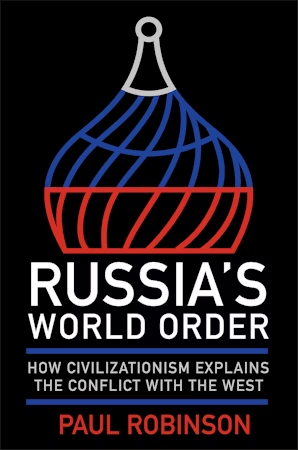
_The book ["The Russian World Order](https://www.cornellpress.cornell.edu/book/9781501780011/russias-world-order/#bookTabs=2)"_ explores the ideas behind the new, undeclared Cold War between Russia and the West. The First Cold War was a conflict between capitalism and communism; Most Western politicians and decision-makers imagine that the new Cold War is a struggle between democracy and tyranny. _The Russian World Order_ makes it clear that, from a Russian point of view, the conflict is about something entirely different: it is a struggle between two contradictory visions of the course of history. _The concept of “Russian World Order**”_ describes the civilizational theory that has come to dominate Russian official discourse, and which the Russian state uses to justify its clashes with the West. While the West promotes a historical vision that pushes all nations toward convergence on a single social, political, and economic model (the model of modern Western liberalism), Russian political leaders increasingly portray the world as consisting of multiple, distinct civilizations, each heading toward its own destination. The Russian state portrays itself as defending the right of all civilizations to chart their own independent development path, and it has had some success in using this logic to win allies around the world. Paul Robinson recounts how ideas of inevitable convergence once dominated Russian thought, before being gradually displaced in favor of civilizational theories. It shows the sources of these theories, their content, and how they gained popularity. Thus, the book “The Russian World Order” reveals the true nature of the new contemporary Cold War, and the challenge that Russian civilizations represent to the West.
Bibliographic Data
| Publisher | Cornell University PressWebsite |
|---|---|
| Publisher Address | ' cupress@cornell.edu |
| Country | USA |
| Primary Category | Ideas and Policies |
| Language | Arabic (AR) |
| Translation | Translated |