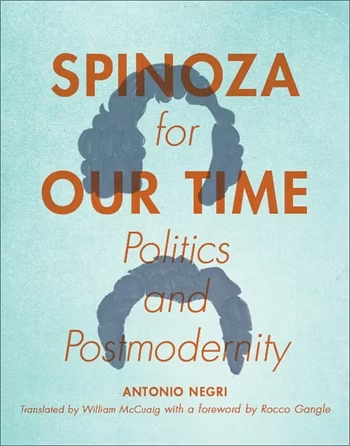
Antonio Negri, one of the world's leading scholars on the thought and contemporary legacy of Baruch Spinoza (1632-1677), provides a clear explanation of the philosopher's detailed arguments and a compelling case for his continuing importance. In response to renewed interest in Spinoza's thought and its applicability to contemporary global issues, Negri demonstrates the particular value of this thinker in politics, philosophy, and related disciplines. Negri's work is both a return to, and a development of, his initial emphasis on Spinoza's thought in The Monstrous Anomaly. He also defends his understanding of the philosopher as a pioneer of postmodernism, or a thinker who, with the advent of postmodernism, now becomes contemporary. Negri also links Spinoza's theories to recent trends in political philosophy, particularly the re-engagement with Carl Schmitt's "political theology", and the history of philosophy, including the argument that Spinoza belongs to the "radical Enlightenment". By positioning Spinoza as a contemporary revolutionary thinker, Negri effectively addresses and challenges the criticisms leveled at the twentieth-century thinker by Jacques Derrida, Alain Badiou, and Giorgio Agamben.
Spinoza for our time: politics and postmodernism
سبينوزا لعصرنا .. السياسة وما بعد الحداثة
Translated
Listen to book
Bibliographic Data
| Publisher | Columbia University Press |
|---|---|
| Publisher Address | ips@ingramcontent.com |
| Country | USA |
| Primary Category | Ideas and Policies |
| Published | 2026 |
| Language | Arabic (AR) |
| Pages | 152 pages |
| Edition | First edition |
| Dimensions | 6x9 |
| ISBN | 9780231224192 |
| Translation | Translated |