القدرات البلاغية .. كيف تُشكّل الدول الصاعدة النظام الدولي؟
القدرات البلاغية .. كيف تُشكّل الدول الصاعدة النظام الدولي؟
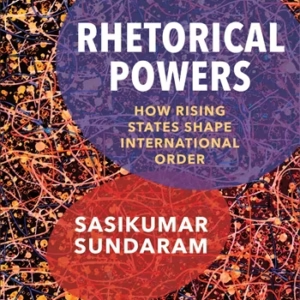
Recent years have witnessed a remarkable resurgence of anti-imperialist and anti-colonial discourse on the international stage, from the Global South to the Global North, and from the left to the right. Why do states use these forms of discourse in world politics? How do practitioners from the so-called non-Western world differ in their use and performance of discourse, and how do they influence the international system? Sasikumar Sundaram offers a bold new theory of discourse as power politics, showing how non-Western states challenge their marginalization within the Western-led international system. It is argued that states at lower levels of the hierarchical international system resort to rhetorical performances to make their voices heard. Through anti-imperialist and anti-colonial political discourse, countries such as India, Brazil, and China seek to expose and exploit contradictions in the principles, norms, and rules that legitimize the international system and, in doing so, seek to exercise power. Today, as Russia, Europe, and even the United States engage in anti-imperialist and anti-colonial discourse, Sundaram demonstrates the importance of lessons from the non-Western world for understanding the dynamics of power politics and global turmoil. The book "Rhetorical Powers" poses a strong challenge to prevailing theories about power in international relations, stressing the need to address persistent forms of marginalization in the international system.
Bibliographic Data
| Publisher | Columbia University Press |
|---|---|
| Publisher Address | ips@ingramcontent.com |
| Country | USA |
| Primary Category | Ideas and Policies |
| Language | Arabic (AR) |
| Translation | Translated |