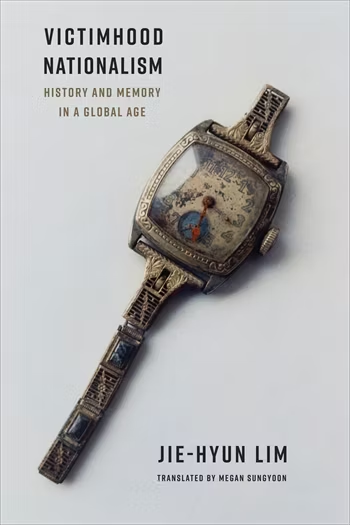
القومية المظلومة .. التاريخ والذاكرة في عصر العولمة
القومية المظلومة .. التاريخ والذاكرة في عصر العولمة
Today's nationalism is based on the concept of victimhood. Historical memory of past suffering gives nationalist movements political legitimacy and a sense of moral superiority. Koreans remember the atrocities of Japanese colonialism, while Japan commemorates the atomic bombings of Hiroshima and Nagasaki. Israel sanctifies the Nazi Holocaust, and Poland praises the Nazi and Soviet occupation. Even Germany and Russia, perpetrators of historical crimes, today portray themselves as victims by pointing to national suffering. In this theoretically sophisticated and empirically rich book, Ji Hyun Lim offers a new way of understanding nationalism and its political exploitation of suffering, developing the concept of “victim nationalism” and exploring it in diverse global contexts. It analyzes the relations between Poland, Germany, Israel, Korea, and Japan, focusing on how memories of colonialism, the Nazi Holocaust, and Stalinist terrorism intertwine and intertwine in transnational spaces. Focusing on the formation of memory, Lim examines how perpetrators in Germany and Japan become victims, and how nationalists in Poland, Korea, and Israel portray themselves as hereditary victims in response to external criticism. It deals with the construction of nations as victims and perpetrators, tracing the interaction of history and memory. The book concludes that challenging grievance-based nationalism is necessary to overcome enduring rivalries over national suffering, and to promote reconciliation, mutual understanding, and cross-border solidarity.
Bibliographic Data
| Publisher | Columbia University Press |
|---|---|
| Publisher Address | ips@ingramcontent.com |
| Country | USA |
| Primary Category | Ideas and Policies |
| Language | Arabic (AR) |
| Translation | Translated |