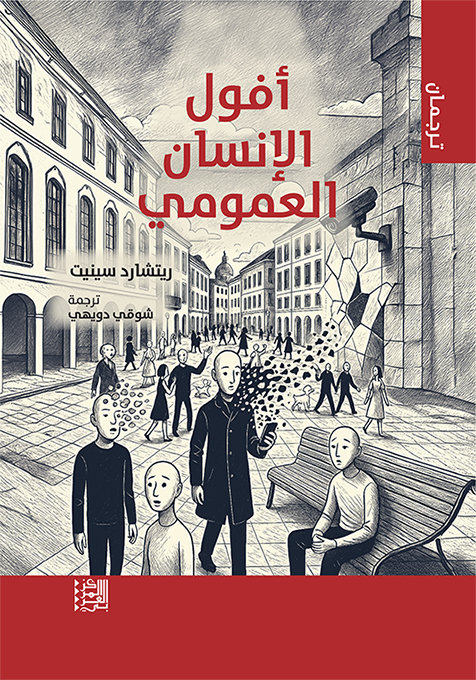
In the book **The Fall of Public Man**, Richard Sennett provides an in-depth analysis of the path of transformations that public life witnessed in the West during the eighteenth and nineteenth centuries, which contributed to the erosion of public culture and the rise of a society dominated by individualism, self-confidence, and the frantic pursuit of Intimacy. He believes that contemporary individuals, in the name of spontaneity and inner honesty, have become so self-aware that they undermine their ability to exercise spontaneity itself. With the increase in sanctification of the personality and self-indulgence, people found themselves stuck in a cycle of proving the existence of a self, in which they only found vague feelings that lacked meaning. Thus, a vicious circle is formed into which Sennett believes modernity has slipped. As the search for self-gratification increases, self-centeredness increases and the connection to the public sphere declines. The author's analysis in his book The Decline of the Common Man revolves around a fundamental idea, which is the loss of the ability to "play", that is, to practice forms of social interaction that combine distance and flexibility, and allow communication without demanding intimacy from the other. Play, in its social sense, represents a means of liberation from the burden of the self and provides a space for integration into the world. He confirms that this ability was strongly present in eighteenth-century cities, such as London and Paris, where public life flourished based on symbols, representation, and social exchange between strangers. Public space then had its own rules and roles, while private space remained another different world, natural and associated with intimacy. This clear separation between the two spaces represented the basis for a healthy balance in the modern social experience. Sennett reviews the collapse of this public theatrical world in the nineteenth century, identifying three main factors behind this transformation: industrial capitalism, new secularism, and the remnants of ideology associated with the ancien régime. He bases his analysis on a variety of historical examples, including demographic shifts, changes in styles of dress, gestures and speech, the transformation of theatre, the rise of department stores, the disappearance of the social role of coffee shops, changing family patterns, the rise of the cult performer, the Dreyfus affair, and the rise of the charismatic leader. Through all of these transformations, social interaction declined and society turned into a crowd of spectators. The idea of a public role disappeared, while the family turned into a safe haven on the basis of which public life was measured and through which its standards were reformulated. This leads to what Sennett calls “anti-urban bias,” an aversion to the distance and difference that characterize urban life. As interaction between strangers decreased, individuals became more isolated and anxious about their own feelings, and engaged in constant attempts to assert themselves without achieving any real satisfaction. Within the framework of this retreat, dominant social forces remain unaccountable, while public order dissolves and social space becomes more fragile. In the modern world, intimacy has become the highest value, and relationships are measured by how close they are to the depths of the soul. This transformation leads to the politicization of internal life, as political categories turn into psychological categories, and close relationships are burdened with a heavy burden of longing for permanence and security. This victory for intimacy creates what the author calls “the tyranny of intimacy,” meaning it creates a stifling social reality that narrows the possibilities for interaction and undermines the distance necessary for a healthy public life. Modern media exacerbates this situation; The unilateral flow of messages via television and radio turns citizens into passive recipients, while the private lives of politicians and celebrities are turned into a consumer item. Thus, interest in personalities replaces interest in politics, and emotion replaces action. Politicians speak for their own desires, so-called “honesty” is celebrated rather than competence, and public engagement is increasingly eroded. Sennett concludes that modern man suffers from a profound symbolic void after the loss of common rituals, myths, and symbols. Intimacy, in this context, becomes a new form of religious nostalgia in a secular age. However, this isolation stifles individuals and deepens their isolation. He believes that overcoming this impasse requires rethinking the sacred and inventing new forms of public life that restore society’s space, distance, play, and meaning. This book is considered one of the pioneering works in the study of modern society, as it provides a deep analysis of the historical transformation in public life. Its importance lies in its ability to connect the individual soul to major social structures
The decline of the common man
أفول الإنسان العمومي
Translated
Listen to book
Bibliographic Data
| Publisher | Arab Center for Research and Policy Studies |
|---|---|
| Publisher Address | office@dohainstitute.edu.qa |
| Country | Qatar |
| Also In | |
| Published | 2025 |
| Language | Arabic (AR) |
| Pages | 512 pages |
| Edition | First edition |
| ISBN | 9786144457146 |
| Translation | Translated |
| Keywords | أفول الإنسان العموميريتشارد سينيت |