
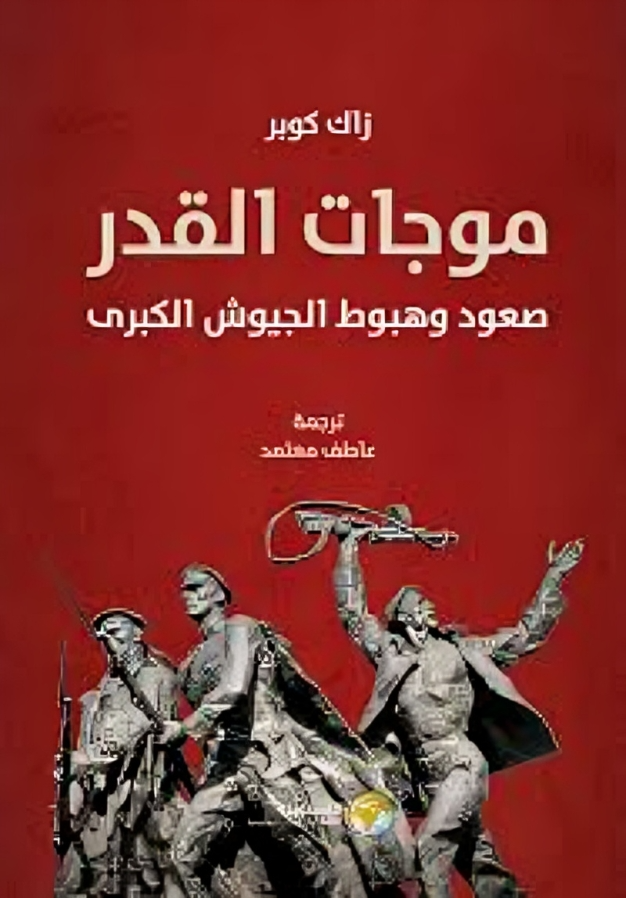
The Arabic translation of the book “Waves of Destiny: The Rise and Fall of Armies” was published by Al-Mustaqbal for Advanced Research and Studies, in Abu Dhabi. Grand](https://futureuae.com/ar-AE/Mainpage/Item/10589/%D9%85%D9%88%D8%AC%D8%A7%D8%AA-%D8%A7%D9%84%D9%82%D8%AF%D8%B1-%D8%B5 %D8%B9%D9%88%D8%AF-%D9%88%D9%87%D8%A8%D9%88%D8%B7-%D8%A7%D9%84 %D8%AC%D9%8A%D9%88%D8%B4-%D8%A7%D9%84%D9%83%D8%A8%D8%B1%D9%89)" By the American researcher Zach Cooper, and completed by Dr. Atef Motamed. The book represents a distinguished research contribution to studies of the rise and fall of major countries that have witnessed a boom in the recent period and that are witnessing profound transformations in the international system. However, the book focuses on one aspect of international power, which is military power. The book explains the patterns of decline and rise of countries' military power based on historical case studies. The main goal of the book is to explore what the military competition between the United States and China will lead to. The latter has recently seemed more inclined to display its military strength and possess conventional and unconventional offensive capabilities. Cooper believes that the question of the rise and fall of major armies has been raised for a long time in studies of international relations, but the explanations offered have always focused on factors such as geography, resources, economics, and culture. But it overlooks the development of “perceived relative power,” which is what this book attempts to address. Its main argument is that the power of states is not isolated from their competitive relationship with others; This makes the “perception” aspect necessary in explaining the defense behavior of countries, and also explains the development of defense investment structures in states of peace and war. The book proposes a new theory: national leaders adopt defense policies consistent with their countries' perceived relative strength; They focus on two factors that appear to be independent but interrelated at the same time: (1) levels of perceived relative power, and (2) trends in perceived relative power. To prove this theory, the book traces the rise and fall of the power of the armies of international powers during the end of the nineteenth century until the end of the twentieth century; The second and third chapters discuss the rise of the United States and Germany at the beginning of the twentieth century. Chapters Four and Five review the height of the influence of Great Britain and France before the First and Second World Wars. Chapters Six and Seven study Japan's decline during World War II, and the Soviet Union's decline with the end of the Cold War. Chapter Eight then concludes by drawing lessons from these cases and discussing their implications for the growing military competition in Asia. The book concludes that while perceived relative power trends between the United States and China may not favor Washington, American leaders have an opportunity to adopt new technologies and strategies that can stabilize the military balance in Asia. This growing debate is embodied in the US Marine Corps' study of a shift toward expeditionary forward base operations, the US Navy's study of distributed maritime operations, the US Air Force's study of agile warfighting employment, and the US Army's introduction of the concept of multi-domain operations. All of this represents an admission that projecting power has become more difficult; Therefore, new strategic concepts are needed.
A COMING-OF-AGE SPACE ODYSSEY: Confessions of a NASA Whistleblower
موجات القدر: صعود وهبوط الجيوش الكبرى
Not Translated
Listen to book
Bibliographic Data
| Author | |
|---|---|
| Publisher | Future Center for Advanced Research and Studies |
| Publisher Address | info@futureuae.com |
| Country | UAE |
| Primary Category | Ideas and Policies |
| Also In | |
| Published | 2025 |
| Language | Arabic (AR) |
| Pages | 355 pages |
| Edition | First edition |
| Dimensions | 14×21 |
| ISBN | 9789948660231 |
| Translation | Not Translated |