
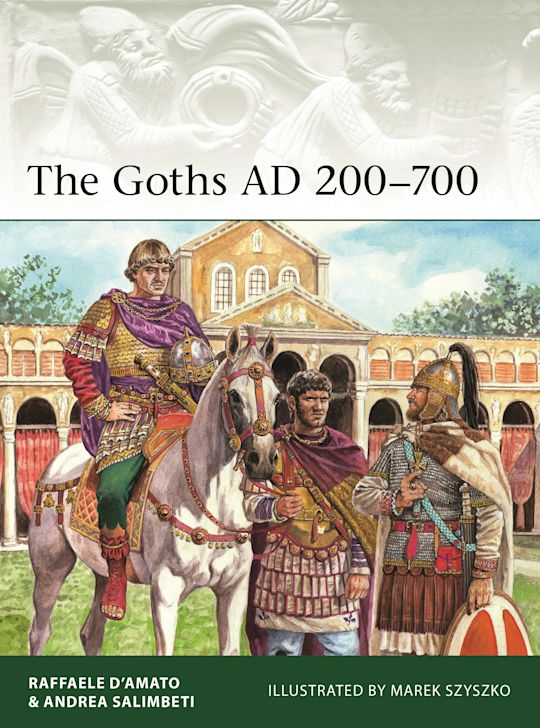
An illustrated study of Rome's most prominent enemies during the late Roman Empire and the era of control: the Visigoths and the Ostrogoths. The Goths were a Germanic people who migrated, under pressure from the Huns, during the second century AD to the Balkans, where they divided into the Visigoths in the west and the Ostrogoths in the east. After their raids and plunder of Roman lands, some of them later joined the ranks of the allies in the empire, but this alliance collapsed after the advance of the Huns, which forced the Goths to retreat south towards the Danube River. The failure of negotiations to settle these new territories under Roman control led to wars, during which the Ostrogoths won a decisive victory over the Roman army at Adrianople (378 AD), and eventually the Visigoths sacked Rome itself (410 AD). In this engaging study, Roman military historians Raffaele D'Amato and Andrea Salimpetti examine the fierce conflicts between Rome and the Goths, exploring their role in the fall of the Western Roman Empire and the gradual transition from the Roman era to the early Middle Ages in Europe. Modern artwork, photographs of artifacts, and expert research combine to bring to life key events in Gothic history, including the defeat of the Ostrogoths at the hands of Emperor Justinian in the sixth century, the establishment of Gothic kingdoms in Italy and the Iberian Peninsula, and their service as subjects and soldiers in the Byzantine Crimea.
Goths 200-700 AD
القوط 200-700 م
Translated
Listen to book
Bibliographic Data
| Author | |
|---|---|
| Publisher | Osprey PublishingWebsite |
| Publisher Address | info@ospreypublishing.com |
| Country | Britain |
| Primary Category | Ideas and Policies |
| Published | 2025 |
| Language | Arabic (AR) |
| Pages | 64 pages |
| Edition | First edition |
| Dimensions | 18×24 |
| ISBN | 9781472863065 |
| Translation | Translated |
| Keywords | القوط 200-700 م |